Your calendar knows more about you than your CRM ever will
The thesis behind Tact. Why the most undervalued dataset in business is the one you look at 30 times a day.
There’s a $80 billion industry built on a lie.
The lie is that CRM data reflects reality. That the fields your team fills out after a meeting capture what actually happened. That pipeline stages updated on Friday afternoon represent the true state of a deal. That “last contacted” timestamps mean anything when half of them were auto-logged by an email sync that counted a mass newsletter as a touchpoint.
Here’s what we know: 83% of CRM data is manually entered. Studies from Salesforce’s own ecosystem show that sales reps spend 28% of their week on data entry. And the data they enter is filtered through memory, optimism, and the very human desire to make a pipeline look healthy.
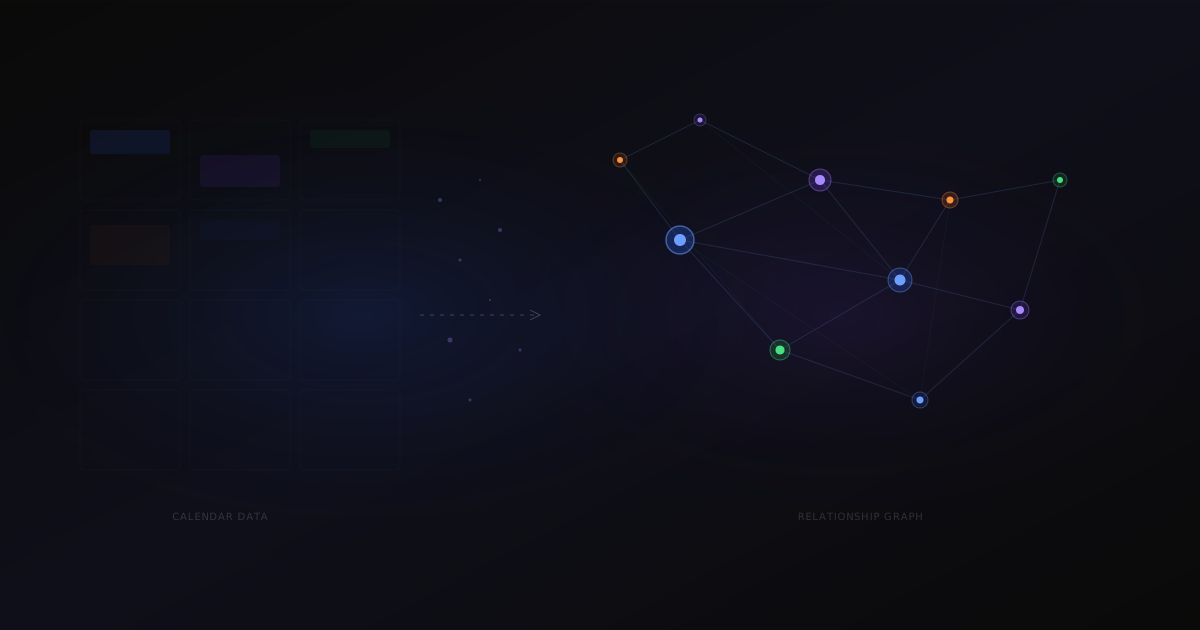
Meanwhile, there’s a dataset that captures what actually happened. Who met whom. For how long. How often. Whether the meeting was rescheduled three times (a signal) or accepted within minutes (a different signal). Whether the CEO joined or sent a delegate. Whether the follow-up happened in 2 hours or never.
That dataset is your calendar.
The calendar is a behavioral record
Every other business tool asks you to describe what happened. Your calendar records what you did.
This distinction matters more than it seems. When a CRM says “last contact: March 1,” it might mean someone sent a templated email. When a calendar shows a 45-minute meeting on March 1 with three attendees from the client side, that’s a fundamentally different data point. The CRM captures the claim. The calendar captures the behavior.
Think about what your calendar actually knows:
Frequency. How often you meet with someone. A board member you see monthly. An investor you haven’t spoken to in 90 days. A client whose meeting cadence just shifted from weekly to biweekly. Each of these patterns is a signal that no CRM field captures.
Duration. A 15-minute check-in means something different from a 90-minute working session. Duration is a proxy for depth of engagement. Your calendar tracks it automatically. Your CRM doesn’t even have a field for it.
Context. The meeting title, the attendee list, the location. “Coffee at Faria Lima” tells you this was informal and in-person. “QBR with full team” tells you this was formal and high-stakes. “Reschedule request from their side” tells you something shifted in priority.
Proximity. Who appears in meetings together? If your investor and your biggest client both show up in the same week’s calendar, there’s a pattern. If a new name keeps appearing in meetings with a key account, someone got promoted or hired. The calendar surfaces these connections. The CRM requires someone to manually update the org chart.
Rhythm. How your meeting patterns change over time. A founder who goes from 12 meetings per week to 30 is scaling. A sales rep whose external meetings dropped by 40% is churning out. A CEO who suddenly has three board-related meetings in a week is dealing with something. Rhythm is the derivative of the calendar, and it tells a story no quarterly report can.
Why CRMs became fiction
CRM adoption is near-universal in B2B. Salesforce alone has over 150,000 customers. HubSpot crossed 200,000. Yet every revenue leader will privately admit the same thing: the data is unreliable.
The root cause isn’t laziness. It’s design.
CRMs were built as databases of record. They assume that humans will faithfully transcribe the messy, nuanced reality of a business relationship into structured fields. Name. Company. Stage. Last contact. Next step. Amount. Close date.
But relationships aren’t structured. A 45-minute coffee with a potential investor covers their portfolio strategy, your hiring plans, a mutual connection’s new company, and a vague expression of interest in your next round. Which CRM field captures that? None of them. So the rep logs “had coffee, seemed interested” and moves on.
Multiply this by every interaction across every relationship, and you get a database that’s technically populated but practically useless. The fields are filled. The truth is missing.
The second problem is temporal. CRMs capture snapshots, not trajectories. They tell you what the state was when someone last updated it. They don’t tell you how the relationship is moving. Is this account heating up or cooling down? Is engagement increasing or declining? A CRM shows you a photograph. A calendar shows you a film.
The relationship health equation
If CRMs are fiction, what does nonfiction look like?
We’ve spent the past year studying how experienced operators (founders, investors, executives running 20+ meetings per week) actually track relationships. The pattern that emerged was remarkably consistent. When these operators assess the health of a professional relationship, they instinctively consider three variables:
Recency. When was the last real interaction? Not the last email. The last meeting where both parties were present and engaged.
Frequency. What’s the cadence? Weekly? Monthly? Quarterly? And more importantly: is the cadence stable, accelerating, or decaying?
Context depth. What happened in those interactions? Surface-level status updates, or substantive conversations where decisions were made and commitments formed?
This is the relationship health equation: Health = f(recency, frequency, context depth).
Every component of this equation is available in calendar data. Recency is the date of the last meeting. Frequency is the interval pattern between meetings. Context depth can be approximated from meeting duration, number of attendees, and (with meeting intelligence) the actual content discussed.
No CRM captures this equation. Your calendar does, passively, without anyone entering a single field.
The infrastructure gap
So if calendar data is this valuable, why hasn’t anyone built on it?
Three reasons.
First, calendar APIs were an afterthought. Google Calendar API launched in 2006 but remained limited in scope and reliability for years. Webhook support for real-time sync was unreliable until relatively recently. Outlook/Exchange APIs had their own fragmentation. Building a reliable, bidirectional calendar sync across providers was (and still is) a meaningful engineering challenge. Most startups avoided it.
Second, calendar data alone isn’t enough. Knowing that a meeting happened is step one. Understanding what happened in the meeting (who said what, what was decided, what was promised) requires a layer of intelligence that didn’t exist until recently. Meeting transcription was expensive and inaccurate. Summarization was manual. The cost of converting a calendar event into actionable intelligence was too high.
Third, the market was sliced wrong. The productivity software market fragmented into narrow verticals: scheduling tools (Calendly, Cal.com), calendar optimization (Reclaim, Clockwise), meeting intelligence (Otter, Fireflies, Granola), CRM (Salesforce, HubSpot, Attio), and follow-up automation (various). Each tool solved one slice. None of them connected the slices into a system.
This fragmentation isn’t accidental. It’s a result of how venture capital funds software: pick a wedge, dominate it, expand later. The problem is that operators don’t experience their workday in wedges. They experience it as a continuous flow: prepare for a meeting, have the meeting, capture what was decided, follow up, track the relationship over time. Breaking this flow into six separate tools is an infrastructure failure.
Why now
Three shifts make this the right moment to build the operating system that connects calendar, meetings, relationships, and follow-through.
LLMs crossed the quality threshold. Meeting summarization went from “barely useful” to “good enough to rely on” in 18 months. Models like Claude and GPT-4 can extract decisions, action items, and relationship context from transcripts with accuracy that would have been impossible in 2023. Whisper made transcription multilingual and affordable. The intelligence layer that was missing is now available.
Calendar infrastructure matured. Google Calendar API v3 with reliable push notifications, Microsoft Graph API for Outlook, and services like Recall.ai for meeting recording created a foundation that didn’t exist five years ago. Building a real-time, bidirectional calendar sync is still hard, but it’s no longer speculative.
Operators are drowning. Meeting count per executive has grown 38% since 2020. The average C-level has 23 meetings per week. The average founder at a Series A+ company has 28. The coordination overhead (scheduling, preparing, summarizing, following up) now consumes more time than the meetings themselves. The pain is acute and universal.
These three shifts converge into an opportunity: build the system that treats calendar data as the primary source of truth for professional relationships, layers AI-powered intelligence on every meeting, and automates the follow-through that operators currently do manually (or more often, don’t do at all).
What the system looks like
The operating system we’re describing isn’t a better calendar. It’s not a better CRM. It’s not a better meeting recorder. It’s the connective tissue between all three.
Here’s what it does:
It starts with your calendar. Not as a grid of time blocks, but as a rich, contextualized view of your professional life. Each event carries information about who you’re meeting, your full history with them, what was discussed last time, what was promised, and how the relationship is trending.
Before a meeting, the system prepares you. Not with a Google search, but with the context that actually matters: the last three interactions with this person, the action items that are still open, the relationship health score, and a note about the commute time so you know when to leave.
During the meeting, it listens (with consent). It transcribes, identifies speakers, and processes the conversation in real time.
After the meeting, it acts. A summary with decisions and action items is generated within minutes. A follow-up draft is written, personalized based on what was discussed, and queued for your review. The relationship profile is updated. The contact graph is enriched. Open items are tracked.
Between meetings, it watches. Relationships that are cooling get flagged. Follow-ups that were promised but not sent get surfaced. The system maintains the operational memory that humans can’t.
This is what we mean by calendar intelligence. Not a smarter grid. A system that understands what your time is being spent on, who matters, what was promised, and what needs to happen next.
The operator’s dilemma
Every operator we’ve spoken to recognizes this problem. They know their calendar is their real operating system. They know their CRM is incomplete. They know they’re dropping follow-ups. They know relationships are cooling while they’re too busy to notice.
But they’ve been trained to accept this as normal. The tax of being busy. The cost of operating at scale.
It’s not normal. It’s an infrastructure problem. And infrastructure problems get solved by building infrastructure, not by trying harder.
Google Calendar was launched the same year as Facebook. 2006. In the 20 years since, Facebook became Meta, built an ad empire, launched VR hardware, and employed 67,000 people. Google Calendar added a “find a time” feature and some color-coded labels. Your life changed. Your calendar didn’t.
That changes now.
What we believe
We’ll end with the principles that guide how we build:
Calendar data is the most honest dataset in business. It captures behavior, not claims. Build on behavior.
Relationships have a half-life. Without active maintenance, every professional relationship decays. Systems should make the decay visible and the maintenance automatic.
Intelligence without action is trivia. Summarizing a meeting is useful. Automatically drafting the follow-up, tracking the commitments, and flagging when something is overdue is transformative. The gap between knowing and doing is where most tools fail.
Operators don’t need more tools. They need fewer tools that do more. Six point solutions stitched together with copy-paste is not a stack. It’s a tax. The operating system should be one system.
The best tool is the one that works without being opened. If an operator has to remember to use it, it fails. The system should work in the background, surfacing what matters when it matters, and staying invisible the rest of the time.
This is the thesis behind Tact. We’re not building a better calendar. We’re building the operating system that should have existed the moment calendars went digital.
Your calendar knows who you spent time with, for how long, how often, and in what context. It has always known. Nobody built the system to make that knowledge useful.
Until now.
Tact is the AI operating system for executives, founders, and operators. Calendar intelligence that schedules around your real life, remembers every relationship, and turns meetings into action. Learn more at usetact.io