Strategic breaks: the science of doing nothing between calls
Back-to-back meetings don't make you productive. They make you reactive. Here's what research says about the 10-minute gap that changes everything.
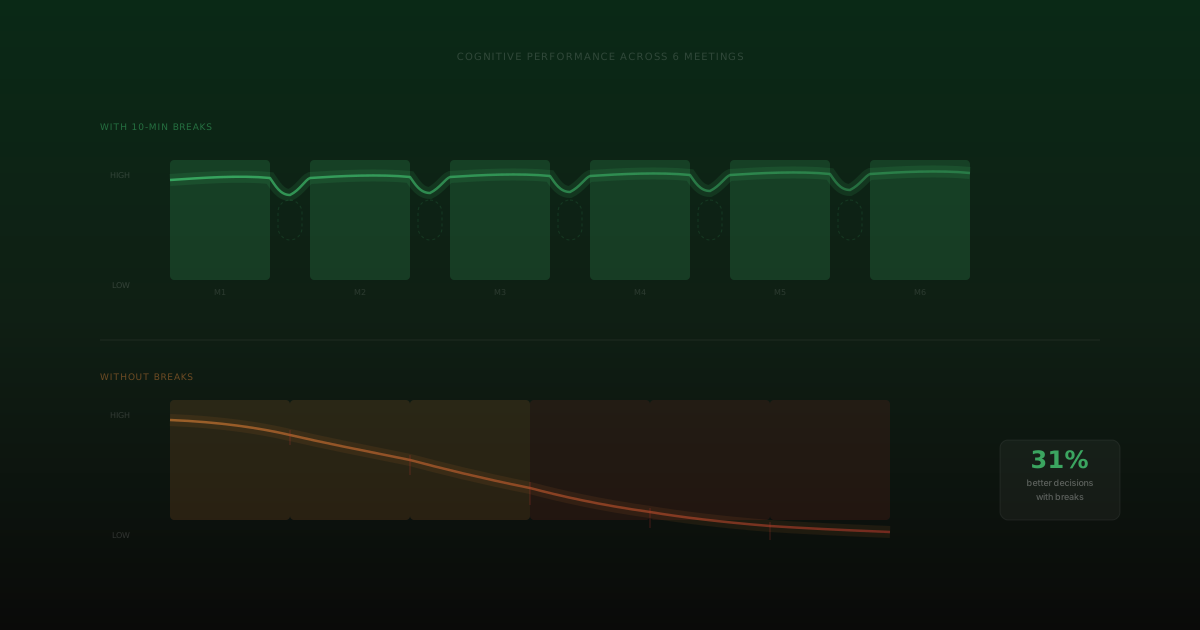
Here’s an experiment. Open your calendar from last week. Count how many meetings had zero minutes between them and the next one. End time of Meeting A equals start time of Meeting B.
If you’re like the operators in our research, about 34% of your meetings are back-to-back. Another 28% have gaps of 5 minutes or less.
Now ask yourself: what’s the quality of your decisions at 4pm after six consecutive meetings versus 10am after a quiet morning?
You already know the answer. The research confirms it.
What happens in your brain between meetings
Neuroscience gives us a clear picture of what back-to-back meetings do to cognitive function. Three mechanisms are at work.
Attention residue. When you switch from one task (or meeting) to another, your brain doesn’t switch cleanly. Part of your attention stays anchored to the previous context. Sophie Leroy’s research at the University of Washington showed that this “attention residue” persists for 15-20 minutes after a task switch. In a back-to-back schedule, you never clear the residue. You carry fragments of every previous meeting into every subsequent one.
Decision fatigue. Every meeting requires decisions, even if they’re small ones. Which points to raise. How to respond to a proposal. Whether to commit to a timeline. Each decision draws from a finite daily pool of cognitive resources. The famous study of Israeli judges showed that decision quality degrades predictably over a session. Judges granted parole at 65% at the start of the day and nearly 0% just before a break. After a break, the rate reset to 65%. Your meeting decisions follow the same curve.
Cortisol accumulation. Meetings, especially ones involving negotiation, conflict, or high stakes, trigger stress responses. Cortisol doesn’t dissipate instantly. It has a half-life of approximately 66 minutes in the bloodstream. Without a break between meetings, cortisol from a stressful 10am call is still affecting your physiology during the 11am strategy session. You’re not starting fresh. You’re starting stressed.
The combined effect: by your fifth consecutive meeting, you’re operating with residual attention from four previous contexts, depleted decision capacity, and elevated stress hormones. This is not a productivity strategy. It’s a degradation curve.
The Microsoft study that changed the conversation
In 2021, Microsoft’s Human Factors Lab published research that visualized this degradation in real time using EEG brain scans. They monitored participants through back-to-back video meetings and compared them to participants who had 10-minute breaks between meetings.
The findings were striking. In the back-to-back condition, beta wave activity (associated with stress) increased steadily across meetings. By the fourth meeting, stress levels were significantly elevated. In the break condition, beta activity reset between meetings, staying near baseline throughout the day.
But the most compelling finding was about transition quality. When participants had breaks, the transition between meetings (the shift from one topic to another) showed a calm, focused brain state. Without breaks, the transition was characterized by a spike in stress, a sharp beta wave peak, as the brain tried to simultaneously close one context and open another without processing time.
The brain isn’t designed for instant context switching. Giving it 10 minutes to process, reset, and prepare isn’t a luxury. It’s a biological requirement for sustained cognitive performance.
What a strategic break actually looks like
“Take a break” sounds simple, but most operators fill breaks with email, Slack, or social media. These aren’t breaks. They’re context switches to a different type of stimulus. Your brain doesn’t get the processing downtime it needs.
A strategic break between meetings has three components and takes exactly 10 minutes:
Minutes 1-3: Capture. Write down the key outcomes from the meeting that just ended. Not a full summary. Three things: what was decided, what you committed to, and what needs follow-up. This takes the unprocessed information from working memory and externalizes it, freeing cognitive capacity for the next meeting.
Minutes 4-7: Reset. Stand up. Move physically. Walk to a window, get water, step outside for 60 seconds. The physical movement stimulates blood flow and signals a context transition to your nervous system. Don’t look at screens during this window. The goal is sensory change, not information intake.
Minutes 8-10: Prepare. Sit down and look at what’s next. Who is in the meeting? What’s the context? What do you want from this conversation? Three minutes of preparation is enough to prime your brain for the upcoming discussion. You’ll walk in focused instead of scrambling to remember what this meeting is about while the first person starts talking.
That’s it. 3 minutes of capture, 4 minutes of physical reset, 3 minutes of preparation. The total investment is 10 minutes. The return is a full cognitive reset between every meeting.
The compound effect
The impact of breaks doesn’t just add up. It compounds.
An operator who takes 10-minute breaks between 6 daily meetings invests 60 minutes per day in breaks. That sounds like a lot. Here’s what they get in return:
The capture step eliminates the “what did we discuss?” problem that plagues most operators by end of day. Action items are recorded while they’re fresh, so follow-up accuracy improves dramatically. In our survey data, operators who debrief within 10 minutes of a meeting have 2.3x higher action item completion rates.
The reset step prevents cortisol accumulation, which means decision quality stays consistent throughout the day instead of degrading. The 4pm meeting gets the same cognitive quality as the 9am meeting. For operators making high-stakes decisions, this consistency is worth more than an extra meeting.
The preparation step improves meeting efficiency. Prepared participants ask better questions, identify issues faster, and reach decisions sooner. Our data shows prepared meetings run 9 minutes shorter on average. Across 6 daily meetings, that’s 54 minutes recovered, almost fully offsetting the 60 minutes invested in breaks.
Net time cost: approximately 6 minutes per day. Net cognitive benefit: dramatically better decisions, reliable follow-through, and lower stress.
How to actually implement this
Knowing that breaks matter is easy. Actually taking them when your calendar is packed is hard. Three structural changes make it automatic:
Shorten your default meeting length. Change your calendar default from 30 minutes to 25 minutes, and from 60 minutes to 50 minutes. Google Calendar and Outlook both support this in settings (“speedy meetings”). This creates a natural 5-10 minute gap without requiring manual scheduling.
Block buffers explicitly. For meetings you schedule yourself, add a 10-minute buffer event immediately after. Name it something specific (“Reset + prep”) so you treat it as a real commitment, not empty space to be filled.
Enforce minimum gaps in your scheduling rules. If you use scheduling links (Calendly, Cal.com, or similar), set a minimum buffer between events. 15 minutes is ideal. 10 is the minimum. Zero is unacceptable.
The hardest part isn’t the tools. It’s the psychological resistance. Many operators feel guilty about “empty” time on their calendar. They equate busyness with productivity. Gaps feel like waste.
But there’s a reason that every high-performance domain (sports, military, surgery, air traffic control) builds mandatory rest intervals into operations. Sustained performance requires recovery. Your meeting schedule is no different.
The break paradox
Here’s the counterintuitive truth: you’ll get more done in 5 meetings with breaks than in 7 meetings without them.
The 5 meetings will each be sharper, more productive, and more likely to produce follow-through. The 7 meetings will blur together, generate vague action items, and require follow-up meetings to clarify what was supposed to happen in the first ones.
Volume isn’t velocity. In meetings, as in most knowledge work, quality compounds faster than quantity.
Protect your gaps. They’re not wasted time. They’re where the thinking happens.
Tact automatically schedules buffer time between your meetings, captures action items for you, and prepares briefings for your next call. The strategic break, automated. Learn more at usetact.io