Stop managing time. Start managing energy.
The most productive founders don't have more hours. They put their best hours on their hardest problems. A framework for energy-aware scheduling.
Every productivity system starts with the same assumption: time is the scarce resource.
It isn’t.
You have the same 24 hours as everyone else. The CEO of a public company has the same 24 hours as a seed-stage founder. The difference isn’t time. It’s energy: how much cognitive capacity you have at any given moment, and whether you’re spending it on the right things.
An hour at 9am after a good night’s sleep is not the same as an hour at 4pm after six meetings. The clock says they’re equal. Your brain says they’re not. One hour produces your best strategic thinking. The other produces your third attempt at reading the same email.
Time management asks: “How do I fit everything in?” Energy management asks: “When am I at my best, and what deserves that?”
The second question is more useful.
The energy curve
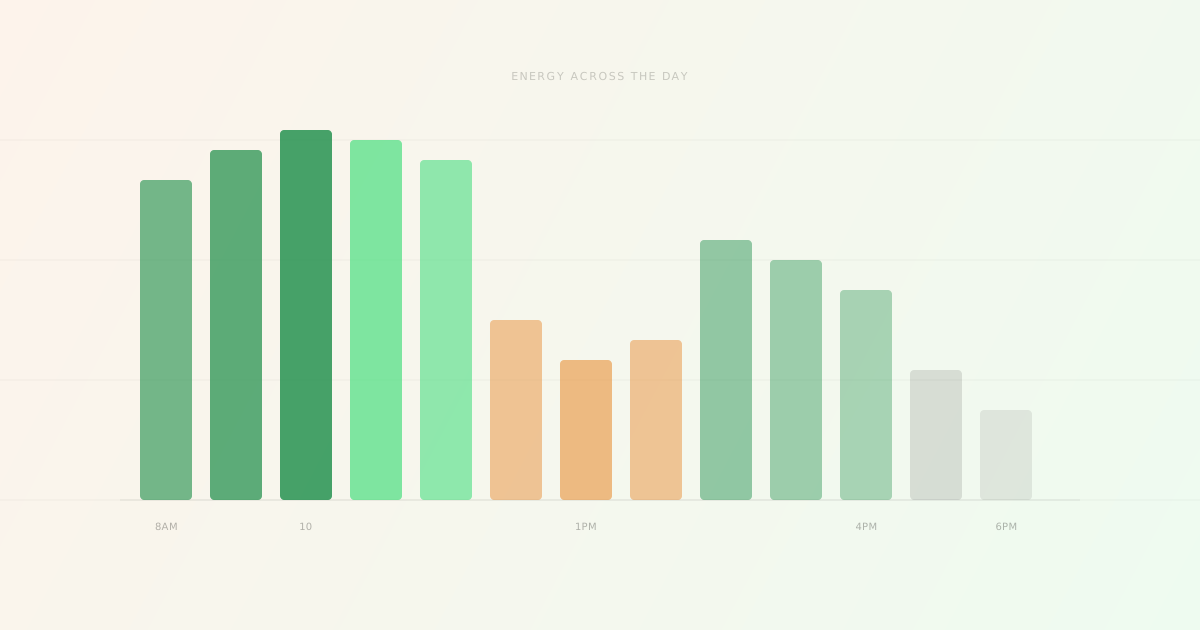
Your energy follows a predictable daily pattern. Not identical for everyone, but consistent enough to design around.
The morning peak (typically 8am-12pm). Cortisol levels are highest in the first few hours after waking. This drives alertness, focus, and the ability to handle complex tasks. For most people, this is the highest-capacity window of the day. It’s also the window most often consumed by meetings, email triage, and Slack catch-up.
The post-lunch dip (typically 12pm-2pm). Blood glucose fluctuations, circadian rhythm, and accumulated cognitive load create a natural trough after lunch. Concentration is harder. Error rates increase. This is the worst possible time for high-stakes meetings or complex decisions. It’s the best possible time for routine tasks, admin, and relationship-oriented conversations that don’t require peak analytical capacity.
The afternoon recovery (typically 2pm-5pm). Energy partially recovers in the mid-afternoon, driven by a secondary cortisol pulse. This window is less intense than the morning peak but sufficient for focused work, especially for people who are naturally late chronotypes. It’s also when creative thinking often peaks, as the slightly loosened cognitive control allows for more associative connections.
The evening fade (5pm onward). Cognitive capacity declines as the day ends. Decision fatigue accumulates. This is when shortcuts get taken, emails get sent that shouldn’t be, and commitments get made that won’t be kept. The worst time to make consequential decisions.
This curve isn’t destiny. It’s a terrain map. You can’t flatten the hills, but you can choose which hills to climb when you’re strongest.
The mismatch problem
Most operators schedule their days by availability, not energy. Someone requests a meeting, and the response is: “I’m free at 10am.” Not: “10am is my peak cognitive window and this meeting doesn’t warrant my best thinking.”
The result is a systematic mismatch between energy and task demands. High-energy hours get consumed by low-value activities. Low-energy hours get assigned high-stakes work.
Here’s what the mismatch looks like in practice:
9am (peak energy): Email triage and Slack catch-up. You’re using your sharpest hour to process other people’s priorities.
10am (peak energy): Internal standup meeting. Your best thinking goes to a status update that could be an async message.
11am (peak energy): Client call that was scheduled because “it was the first available slot.” The call goes well because you’re sharp.
12pm (declining energy): Lunch.
1pm (trough): Board deck review. Your most cognitively demanding task of the day, assigned to your worst cognitive hour.
3pm (partial recovery): Back-to-back internal meetings. Moderate-value work during a moderate-energy window. Acceptable, but the recovery window that could have been used for a focus block is gone.
5pm (evening fade): Finally “free” to do deep work. But you’re running on fumes. The strategy document you planned to write takes twice as long and is half as good as it would have been at 9am.
This is not a time management problem. You had plenty of time. It’s an energy allocation problem. Your best hours went to your least important work.
The energy-aware calendar
Fixing the mismatch requires three structural changes to how you schedule.
Change 1: Classify your tasks by energy demand.
Not all work requires the same cognitive intensity. Group your tasks into three tiers:
Tier 1 (Peak required): Strategy, writing, complex analysis, difficult conversations, creative work, anything where the quality of your thinking directly determines the outcome.
Tier 2 (Moderate): Most meetings, reviews, feedback, planning, structured problem-solving. Important but not at the boundary of your cognitive capacity.
Tier 3 (Low): Email, Slack, admin, scheduling, routine updates, simple approvals. Tasks that need to get done but don’t benefit from your best thinking.
Most operators spend their peak hours on Tier 3 work because it’s “quick” and feels productive. It’s not productive. It’s efficient at the wrong things.
Change 2: Map tasks to energy windows.
Once you know your energy curve and your task tiers, the mapping is straightforward:
Morning peak: Tier 1 work only. One or two 90-minute focus blocks. No meetings unless they’re genuinely Tier 1 (board-level decisions, critical negotiations, high-stakes client calls).
Post-lunch dip: Tier 3 work. Email, admin, scheduling, routine approvals. This is when you clear the queue. The work gets done, and you’re not wasting high-energy hours on it.
Afternoon recovery: Tier 2 work. Most meetings land here. Internal syncs, 1:1s, regular client check-ins, project reviews. These meetings benefit from moderate energy and don’t require peak capacity.
Evening fade: Stop. Or at minimum, only Tier 3 work. No decisions. No commitments. No emails you’ll regret.
Change 3: Defend the mapping with structure.
A map without enforcement is just a wish. Three structural defenses:
Block your peak hours on the calendar before anything else. Recurring events. “Strategy block” or “Deep work.” Visible to anyone who checks your availability. These are the first things placed on the calendar, not the last.
Set your scheduling link to offer only afternoon slots by default. Most external meeting requests don’t need your morning peak. If someone can only meet at 10am, you can make an exception. But the default should protect your best hours.
Communicate the pattern to your team. “I do deep work in the mornings and take meetings after 1pm.” It’s a simple statement that saves dozens of negotiation cycles per week. Most people respect it once they know it exists.
Energy budgets
Here’s a concept that most productivity frameworks miss: you have an energy budget, and meetings are the biggest line item.
Think of your daily energy as a bank account with a fixed deposit each morning. Every activity withdraws from the account. Simple tasks (email, Slack) make small withdrawals. Meetings make larger ones. High-stakes or emotionally charged meetings make the largest withdrawals of all.
A useful exercise: assign energy costs to your typical meeting types.
A routine internal standup: 1 unit. A 1:1 with a direct report: 2 units. A client presentation: 4 units. A board meeting: 6 units. A difficult conversation (performance review, negotiation, conflict resolution): 8 units.
If your daily budget is 20 units, and you’ve scheduled a board meeting (6), a client presentation (4), two 1:1s (4), a team meeting (2), and a difficult conversation (8), you’ve spent 24 units. You’re overdrawn by lunch.
This is why operators feel exhausted on “heavy” meeting days even when the total hours aren’t unusual. It’s not the hours. It’s the energy cost of the specific meetings.
Energy budgeting changes how you schedule. If Wednesday has a board meeting and a difficult conversation, you don’t also schedule the client presentation. You move it to Thursday, when the budget can absorb it. If Tuesday is full of low-energy meetings, you might have leftover budget for an extra focus block.
No one does this math consciously. But the best operators do it intuitively. They “save energy” for big moments. They protect days before important events. They know that a packed Monday means a lighter Tuesday. They’re managing energy, even if they call it something else.
Recovery is not optional
The final piece of energy management is recovery. Not vacation-level recovery. Daily recovery.
Every expenditure of cognitive energy needs a corresponding recovery period. The ratio isn’t 1:1 (you don’t need 45 minutes of recovery for every 45-minute meeting), but it’s not zero either.
Three recovery practices that high-performance operators use:
Transition rituals. A 5-minute routine between meetings that signals “context closed” to your brain. Write down what was decided. Stand up. Walk 30 steps. Sit down for the next thing. The physical movement creates a neurological boundary between contexts.
Energy check-ins. Twice a day (midmorning and midafternoon), spend 30 seconds asking: “How’s my energy? Am I on track for what’s ahead?” If you’re depleted and have a high-energy meeting coming, you have time to adjust: take a break, have a snack, go outside for two minutes. If you wait until you’re in the meeting to realize you’re running on empty, it’s too late.
Hard stops. Pick a time when the workday ends. Not when the work ends (it never ends) but when you stop. A hard stop at 6pm or 7pm creates a recovery boundary that prevents the evening fade from becoming the evening grind. Tomorrow’s peak energy depends on tonight’s recovery.
The energy advantage
Time management tries to squeeze more into the same hours. Energy management makes the existing hours produce more.
An operator who protects their morning peak for Tier 1 work, batches meetings into the afternoon, and respects recovery rhythms will outperform an operator who works longer hours but allocates energy randomly. Not by a small margin. The gap compounds daily.
After a month, the energy-managed operator has produced 40+ hours of peak cognitive work. The time-managed operator has produced the same number of total hours but only 10-15 hours at peak capacity. The rest was diminished by misallocation, fatigue, and context-switching.
Your calendar doesn’t know about your energy. It shows every hour as equal. It’s lying. The hours aren’t equal. And once you stop treating them as if they are, everything changes.
Tact learns your energy patterns from meeting data and protects your peak hours automatically. Because a 9am that’s spent on email is a 9am that’s wasted. Learn more at usetact.io