What your meeting-to-action ratio says about your team
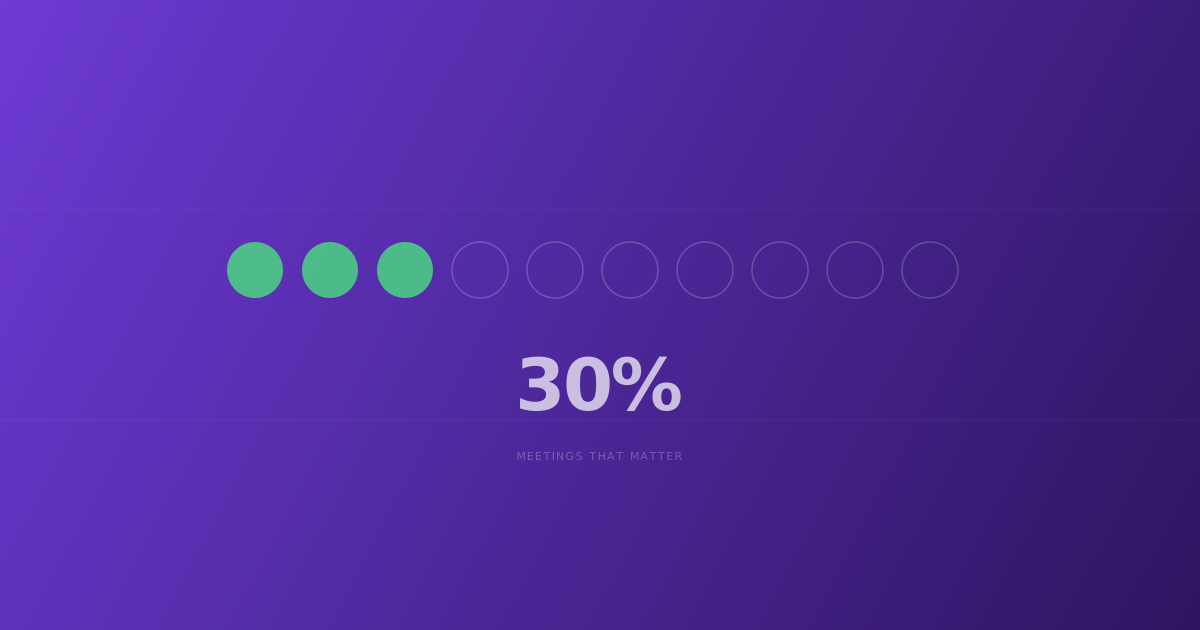
High-performing teams convert 70%+ of meeting decisions into completed action items within 7 days. Most teams? Under 30%.
There’s a metric that no dashboard tracks but every operator feels: the ratio between what gets decided in meetings and what actually gets done afterward.
Call it the meeting-to-action ratio. For every 10 decisions or commitments made in meetings, how many result in a completed action within 7 days?
High-performing teams operate at 70% or above. A decision made on Monday is executed by Friday. The meeting produced an outcome, not just a conversation.
Most teams are below 30%. Seven out of ten commitments made in meetings evaporate. The decision was made. The action wasn’t taken. The next meeting revisits the same topic because the last meeting’s output didn’t survive.
If you’ve ever sat in a meeting and thought “didn’t we already decide this?”, you’ve experienced a low meeting-to-action ratio.
Why the ratio matters more than meeting count
The productivity conversation fixates on meeting count. “We have too many meetings.” “Let’s have fewer meetings.” “This meeting could have been an email.”
Meeting count is a red herring. The real question isn’t how many meetings you have. It’s how many meetings produce outcomes. A team with 30 weekly meetings and a 70% action ratio produces 21 outcomes per week. A team with 15 weekly meetings and a 20% action ratio produces 3.
The second team has half the meetings and one-seventh the output. Fewer meetings didn’t help. They just had fewer opportunities to produce results that also went unexecuted.
The meeting-to-action ratio is a measure of organizational metabolism. It tells you how efficiently your team converts conversation into execution. A low ratio means your meetings are overhead. A high ratio means they’re engines.
Measuring your ratio
You can’t improve what you don’t measure. Here’s how to calculate your team’s meeting-to-action ratio over a 2-week period.
Step 1: Track commitments. For every meeting, document every commitment made. Not agenda items. Commitments. “We decided to…” and “X will do Y by Z.” Include both decisions (agreed directions) and action items (specific tasks with owners and deadlines).
Step 2: Count completions. After 7 days, check each commitment. Was the decision implemented? Was the action item completed? Was it completed on time?
Step 3: Calculate. Divide completions by total commitments. That’s your ratio.
Most teams who measure this for the first time are shocked. The number is almost always lower than expected. Not because the team is lazy or incompetent, but because the system between “meeting” and “action” is broken.
Why commitments evaporate
Meeting commitments fail for structural reasons, not motivational ones. Three primary failure modes:
Failure mode 1: The commitment was never captured. The meeting ends. Everyone remembers the general discussion. Nobody wrote down the specific commitment. By the next day, memories diverge. Did we agree to August 15 or August 30? Was Sarah supposed to send the proposal or review it?
Uncaptured commitments have a completion rate near zero. Not because people don’t intend to follow through, but because they can’t act on something they don’t precisely remember. The specificity of the commitment (who, what, when) is the first thing that degrades in memory.
Failure mode 2: The commitment has no owner. “We should update the pricing page.” Who is “we”? When? A commitment without a specific person assigned to it belongs to everyone, which means it belongs to no one. Collective commitments are the most common type in meetings and the least likely to be completed.
Failure mode 3: The commitment has no deadline. “Let’s revisit this next week” is not a deadline. “Sarah sends the revised proposal by Thursday EOD” is a deadline. Without a specific date, commitments join an ever-growing backlog that competes with everything else on the person’s plate. And in that competition, the item with a deadline beats the item without one, every time.
These three failure modes account for the vast majority of evaporated commitments. The fix is straightforward: capture every commitment with a specific owner and a specific deadline, immediately, before the meeting ends.
The capture problem
If the fix is so simple, why don’t teams do it?
Because capture is structurally difficult in a meeting context. The person taking notes is also participating in the discussion. The transition from “discuss” to “decide” is often unclear. Commitments are sometimes implied rather than stated. And the end of a meeting is rushed, with everyone context-switching to the next thing.
The result: meeting notes (when they exist) tend to be a narrative of what was discussed, not a structured list of what was decided and committed. A narrative is useful for context but useless for accountability. You can’t assign a deadline to a paragraph.
The capture problem has two solutions. The manual solution: designate a “commitment tracker” for each meeting whose sole job in the last 3 minutes is to read back every commitment with owner and deadline. “Here’s what we agreed: Sarah sends revised proposal by Thursday. Mike reviews security audit by Monday. We reconvene next Wednesday at 2pm.” This read-back serves dual purpose: it captures the commitments and gives everyone a chance to correct misunderstandings.
The automated solution: a system that records the meeting, identifies commitments from the transcript, extracts owners and deadlines, and presents them for confirmation. This is what modern meeting intelligence tools can now do reliably. The AI captures commitments as they’re spoken, eliminating the manual burden and reducing the gap between discussion and documentation.
From capture to completion
Capturing commitments is necessary but not sufficient. The commitment must travel from the meeting to the place where work gets done: a task list, a project board, a follow-up sequence.
Many commitments die in the gap between “captured in meeting notes” and “tracked in a workflow.” The meeting notes sit in a document. The action items don’t get transferred to Jira, Asana, or wherever the team manages work. By the time someone checks the meeting notes (if ever), the deadline has passed.
This transfer step is another point of structural failure. The fix: commitments from meetings should automatically flow into the team’s workflow tools. A commitment captured in a meeting should appear as a task with an owner and deadline in the system of record, without requiring someone to manually create it.
The fewer manual steps between “commitment made” and “commitment tracked,” the higher the completion rate.
Accountability without micromanagement
Once commitments are captured and tracked, accountability becomes visible. Everyone can see what was committed, by whom, and whether it’s on track.
This visibility often raises discomfort. It can feel like surveillance. The key distinction: accountability is about commitments, not activity. You’re not tracking how many hours someone worked or what they did minute by minute. You’re tracking whether the things they agreed to do in meetings actually got done.
This is a lower bar than most project management systems set. And it’s a higher bar than most meetings enforce. The gap between these two bars is where meeting value dies.
Three practices that create accountability without micromanagement:
Start each meeting with a commitment review. Before the new agenda, spend 2 minutes reviewing the commitments from the last meeting. What was completed? What wasn’t? This isn’t a judgment session. It’s a calibration. When people know that commitments will be reviewed, completion rates increase dramatically. The review itself is the accountability mechanism.
Make the ratio visible. Track the team’s meeting-to-action ratio and share it. Not punitively, but as a collective metric. “Our ratio last month was 42%. Our goal is 60%.” When the metric is visible and owned by the team, improvement becomes a shared objective.
Identify systemic blockers. When commitments consistently fail, the cause is usually systemic, not individual. Too many competing priorities. Unclear authority to act. Dependencies on other teams. Unrealistic timelines. Address the system, not the person.
The compound effect of a high ratio
Teams with a high meeting-to-action ratio experience a virtuous cycle.
Meetings become shorter because less time is spent revisiting old decisions. Trust increases because people do what they say they’ll do. Fewer follow-up meetings are needed because the first meeting’s output was implemented. Decision quality improves because people know that decisions will be acted on, which makes them more thoughtful about what they decide.
The opposite cycle is equally powerful and more common. Low ratio leads to repeated discussions, which leads to longer meetings, which leads to meeting fatigue, which leads to disengagement, which leads to even lower follow-through. The cycle reinforces itself.
Breaking the negative cycle requires intervention at the structural level: better capture, clearer ownership, explicit deadlines, and visible accountability. None of these require cultural transformation. They require a system.
Your meetings aren’t too many. They’re too leaky. Fix the leak, and the meetings you have will be worth having.
Tact captures every commitment from your meetings, assigns owners and deadlines, tracks completion, and starts each meeting with a review of what was promised. Your meeting-to-action ratio, measured and managed. Learn more at usetact.io