The meeting inflation crisis nobody talks about
Meeting count per executive grew 38% since 2020. Duration dropped 22%. More meetings, shorter each, and worse for deep work than ever.
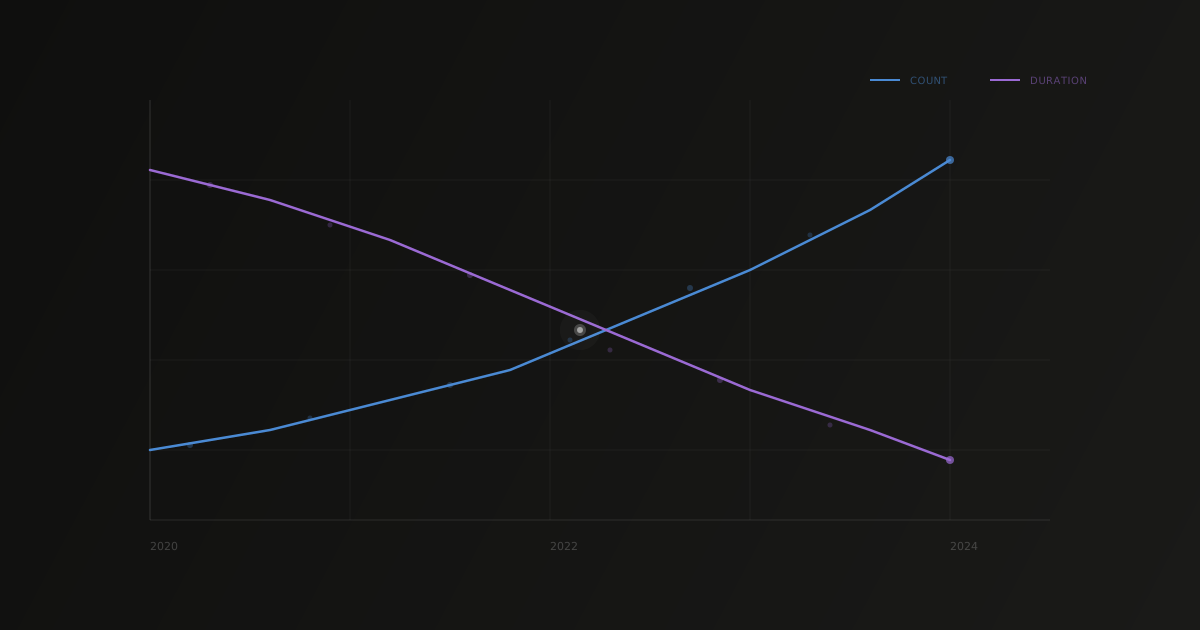
Between 2020 and 2025, something happened to the corporate calendar that nobody planned and nobody stopped. Meeting count per knowledge worker increased by 38%. Average meeting duration decreased by 22%. The total time spent in meetings stayed roughly flat.
On paper, that looks neutral. Same total hours, just distributed differently. In practice, it’s a catastrophe for deep work.
Here’s why: context-switching cost is a function of meeting count, not meeting duration. Each meeting transition requires 15-25 minutes of cognitive recovery, regardless of whether the meeting was 15 minutes or 60 minutes. If you have four 60-minute meetings per day, you pay the switching cost four times. If you have eight 30-minute meetings, you pay it eight times. Same total meeting hours. Double the cognitive overhead.
The shift from fewer long meetings to more short meetings didn’t save time. It destroyed it.
How we got here
Three forces drove meeting inflation.
Remote work eliminated friction. In an office, scheduling a meeting required finding a room, coordinating physical presence, and accepting the implicit cost of pulling people away from their desks. Remote work reduced the friction to near zero. “Let’s hop on a quick call” became the default response to any question that required more than one Slack message.
The data confirms this. Microsoft’s Work Trend Index showed that weekly meeting time per user increased 252% between February 2020 and February 2022. While some of that increase reversed as pandemic conditions eased, the new baseline settled roughly 35-40% above pre-2020 levels. The friction that used to regulate meeting creation never fully returned.
Async communication failed to scale. The promise of tools like Slack and Notion was that they would replace meetings with written communication. For some workflows, they did. For many, they created a new problem: information overload that was harder to process than a meeting.
A 30-minute meeting has a clear start and end. A Slack thread has neither. It fragments attention across hours or days, requires checking back repeatedly, and often fails to reach a clear conclusion. For many teams, meetings became the escape from async overload, not the other way around.
Management anxiety drove check-in culture. In a remote or hybrid environment, managers lost the ambient awareness that comes from physical proximity. You can’t see whether your team is working, engaged, or struggling when everyone is behind a screen. The response was more check-in meetings. Daily standups. Weekly syncs. Biweekly reviews. Each one individually brief and arguably useful. Collectively, they consumed the calendar.
A common pattern: a team of 8 with a daily 15-minute standup (75 min/week per person), weekly team meeting (60 min), biweekly 1:1s (30 min/week average), and monthly retrospective (60 min/month). Total: roughly 3 hours per week per person in recurring meetings alone, before a single project-specific or external meeting is scheduled.
The fragmentation tax
Meeting inflation doesn’t just consume time. It fragments it.
Consider two schedules with identical meeting hours:
Schedule A: Three meetings, each 60 minutes, clustered between 9am and 12pm. The afternoon is a continuous 5-hour block.
Schedule B: Six meetings, each 30 minutes, spread across the day at 9am, 10:30am, 12pm, 1:30pm, 3pm, and 4:30pm. The gaps between meetings are 60-90 minutes each.
Both schedules have 3 hours of meetings. But Schedule A produces 5 hours of uninterrupted work time. Schedule B produces zero hours of uninterrupted work time. Every gap is bounded by meetings, which means each gap carries the cognitive overhead of recovering from one meeting and anticipating the next.
This is the fragmentation tax: the difference between total hours and usable hours. In Schedule B, the 5 hours of “free time” are effectively 2-3 hours of productive time after accounting for context-switching costs. The other 2-3 hours are lost to transitions.
The fragmentation tax is invisible in most calendar tools. They show free slots and booked slots. They don’t show the quality of free slots. A 90-minute gap between two back-to-back meetings and a 90-minute gap in an otherwise empty afternoon look identical on the calendar. They are not identical to your brain.
The short meeting illusion
Meeting inflation was enabled by a well-intentioned belief: shorter meetings are better. If a 60-minute meeting can be 30 minutes, that’s a win. If a 30-minute meeting can be 15 minutes, even better.
In isolation, this is true. A meeting that accomplishes its goals in 30 minutes instead of 60 saves 30 minutes.
But the saved time wasn’t returned to deep work. It was reinvested in more meetings. “I have a free 30 minutes, I’ll take that call.” The total meeting hours stayed flat, but the meeting count, and with it the context-switching tax, went up.
There’s a paradox at work: making individual meetings more efficient made the overall calendar less effective. Optimization at the meeting level degraded performance at the day level.
The solution isn’t longer meetings. It’s fewer meetings with proper batching, so that the time saved by efficient meetings becomes contiguous blocks of deep work rather than more meeting opportunities.
Measuring meeting inflation in your own calendar
Before you can address meeting inflation, you need to quantify it. Three metrics to track:
Meeting count per week. Count every scheduled meeting, including standup, including “quick syncs,” including the 15-minute check-ins that don’t feel like meetings. The average operator underestimates by 35%. Your calendar has the real number.
Average gap between meetings. Sum the total gap time between consecutive meetings and divide by the number of gaps. If your average gap is under 30 minutes, your calendar is fragmented beyond the point of productive deep work between meetings.
Longest uninterrupted block per day. For each day, identify the longest stretch without any meeting. If this is consistently under 90 minutes, you cannot achieve a full focus cycle on any day. This is the most important metric of the three, because it represents your maximum possible depth of work.
Track these for two weeks. The numbers will likely surprise you. They usually do.
Reversing meeting inflation
Meeting inflation is a collective action problem. You can’t solve it alone if your organization’s culture creates meeting pressure. But you can reduce your personal exposure with three structural changes.
Audit your recurring meetings. List every recurring meeting on your calendar. For each one, answer: “If this meeting didn’t exist, what would break?” If the answer is “nothing meaningful,” cancel it. If the answer is “communication would suffer,” consider whether an async update could replace it. Most operators find that 20-30% of their recurring meetings can be eliminated or reduced in frequency.
Set a meeting budget. Decide the maximum number of meetings per day and per week that’s sustainable for your role. For most operators, this is 4-6 per day and 20-25 per week. Once you’ve set the budget, treat it as a hard constraint. When a new meeting request would exceed the budget, something has to move. This forces prioritization that the calendar alone doesn’t provide.
Batch aggressively. This is the structural fix. Meetings create less damage when they’re clustered together than when they’re spread across the day. Designate specific windows for meetings (afternoons, for example) and protect the rest. The same 4 hours of meetings produce dramatically less fragmentation when they’re consecutive than when they’re scattered.
Meeting inflation happened gradually, over five years, without any single decision causing it. Reversing it requires deliberate, structural choices about how your calendar works. The meetings aren’t going to remove themselves.
Tact tracks your meeting count, fragmentation score, and longest focus block automatically. When your calendar inflates, you’ll see it before it costs you. Learn more at usetact.io