The follow-up gap: why founders lose deals in the 48 hours after a meeting
67% of follow-ups sent after 48 hours get no response. Timing is the product.
The meeting went well. Genuinely well. The investor leaned in. The client asked detailed questions about implementation. The potential partner suggested a concrete next step.
You walked out thinking: “I need to send a great follow-up.”
Then the next meeting started. Then three more. Then the day ended. Then the next day was full. Then it was Thursday, and the momentum from Monday’s meeting had dissipated like heat from a cooling engine.
You send the follow-up on Thursday. It’s thoughtful. It references what was discussed. It proposes next steps. But the response comes 4 days later, if it comes at all. It’s polite but lukewarm. The urgency that was palpable on Monday is gone.
This is the follow-up gap: the window between a meeting’s end and the follow-up message, during which momentum, goodwill, and specificity all decay.
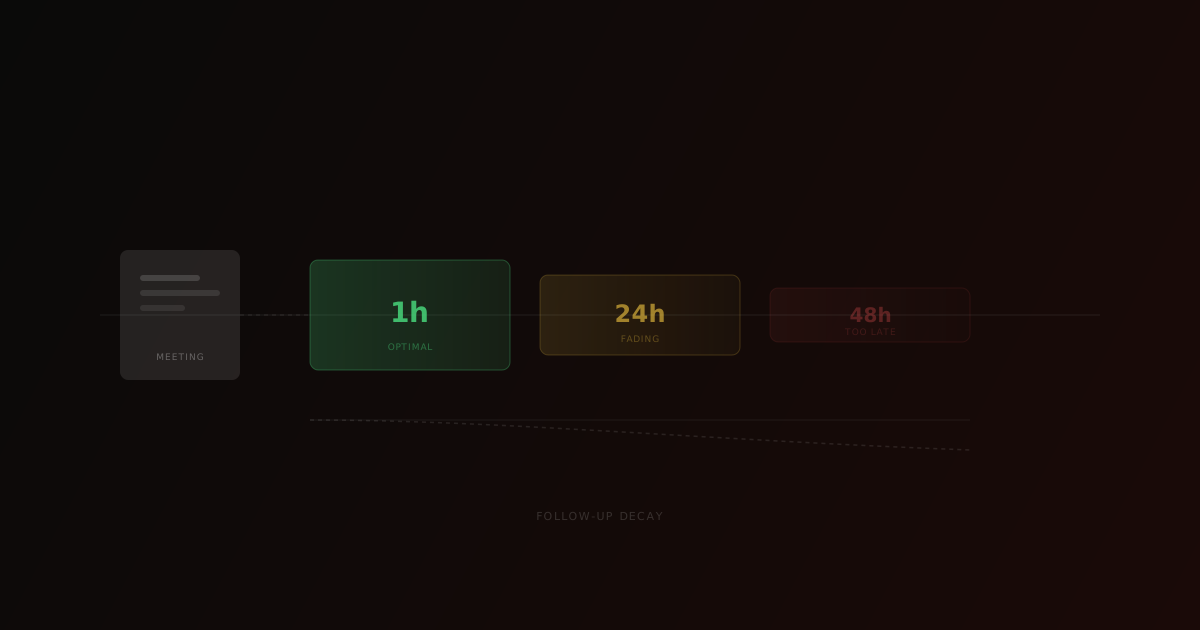
Our data shows the gap in stark terms: follow-ups sent within 1 hour of a meeting receive responses at 3.2x the rate of follow-ups sent after 48 hours. Not just faster responses. More responses. The 48-hour mark is a cliff. Beyond it, the engagement curve flattens.
Why speed matters
The follow-up gap isn’t about professionalism or etiquette. It’s about cognitive states.
During a good meeting, both parties are in a shared cognitive state. They’ve built a temporary context: shared language, mutual understanding, emotional resonance. This context is fragile. It exists in working memory, not long-term memory. It’s vivid and accessible for hours, faded by the next day, and largely gone by 48 hours.
A follow-up sent within an hour operates inside this shared context. The recipient reads it and re-enters the meeting’s mental space almost instantly. The references make sense. The proposals feel natural. The momentum continues.
A follow-up sent after 48 hours operates outside the shared context. The recipient has to reconstruct what was discussed. The meeting has been pushed down by 20 other interactions. The follow-up feels like it’s arriving from a previous chapter. Even if the content is identical, the experience of receiving it is different. The window of shared context has closed.
This is why first-date advice universally says to text the next day, not three days later. The same psychology applies to business. Momentum is perishable.
The specificity decay
Speed isn’t the only variable. The quality of follow-ups also degrades with time.
A follow-up written 30 minutes after a meeting is specific. You remember the exact phrasing of their concern. You can reference the specific example they gave. You can respond to the nuance in their reaction when you presented the pricing.
A follow-up written 3 days later is generic. The specific phrasing is gone. The nuance is lost. What remains is the general impression. “It was a good meeting. They seemed interested.” The follow-up reads like it could have been written about any meeting with any person. Because at this point, it essentially was.
Generic follow-ups get generic responses. Specific follow-ups get engaged responses. And specificity decays with time.
The best follow-ups contain at least one element that could only have been written by someone who was in that specific meeting. A reference to something the other person said. A response to a concern they raised. A resource related to their specific situation. These elements signal attention, competence, and genuine interest. They’re also the first things you forget.
The structural problem
If fast, specific follow-ups produce better outcomes, why don’t operators send them?
Because the structure of their day makes it nearly impossible.
The meeting ends at 11:30am. The next meeting starts at 11:30am (or 11:45 if they’re lucky). The debrief window is zero. The follow-up gets deferred. “I’ll write it during lunch.” But lunch is consumed by the inbox that’s been ignored all morning. “I’ll write it after my 3pm.” But the 3pm runs long and becomes a 4pm and a 5pm.
By the time the operator has an uninterrupted 15 minutes to write a thoughtful follow-up, it’s the next day. Or the day after. The window has closed.
This isn’t a discipline problem. It’s a scheduling problem. The follow-up isn’t scheduled. It’s aspirational. And aspirational tasks lose to scheduled tasks every time.
Closing the gap
Three approaches to consistently closing the follow-up gap.
Approach 1: The 2-minute draft. Immediately after the meeting (literally as you’re walking to the next one), voice-dictate or type a 2-3 sentence follow-up on your phone. Not polished. Not perfect. But specific and fast.
“Great meeting today. The point you raised about implementation timeline is important. I’ll have the revised proposal with the August dates by Thursday. Looking forward to the next step.”
That’s 30 seconds to write and captures the specificity that will be gone tomorrow. You can polish it later if needed. But more often, the draft is good enough to send as-is.
Approach 2: Block follow-up windows. After every high-stakes meeting, block 15 minutes on your calendar for follow-up. Not “when I have time.” Blocked. Immediately following the meeting. This turns follow-up from an aspirational task into a scheduled one. Scheduled tasks get done.
Approach 3: Pre-write the structure. Before the meeting, create a follow-up template with blanks. “Thanks for [topic]. I appreciated your perspective on [specific point]. As discussed, I’ll [action item] by [deadline]. Looking forward to [next step].” After the meeting, fill in the blanks. This reduces the cognitive effort of writing from “compose a message” to “fill in specifics,” which takes 2 minutes instead of 15.
All three approaches share a common principle: reduce the friction between meeting end and follow-up send. The lower the friction, the shorter the gap.
The automated follow-up
The logical endpoint of friction reduction is automation. A system that was in the meeting (recording, transcribing) can draft a follow-up that includes specific references to what was discussed, proposed action items based on commitments made, and contextually appropriate next steps.
The human’s role shifts from writing to reviewing. A 15-minute composition task becomes a 2-minute review-and-send task. The follow-up goes out within the hour. Every time.
This isn’t about replacing human judgment. The operator still decides what to include, what tone to strike, and whether to send at all. But the heavy lifting of remembering, composing, and formatting is handled by a system that was paying perfect attention during the meeting.
The result: follow-ups that are faster, more specific, and more consistent than what any human can produce under the time pressure of a packed calendar.
Timing as competitive advantage
In a world where everyone has access to the same information and similar capabilities, execution speed is a differentiator. The founder who follows up within an hour stands out. Not because the follow-up is better (though it usually is, thanks to specificity). Because it signals something about how they operate.
Speed of follow-up communicates: I was present in our conversation. I value our interaction. I execute. I don’t let things slip.
These are precisely the qualities that investors, clients, and partners evaluate. Not explicitly. Not on a scorecard. But in the accumulated impression formed by dozens of small signals over time. And the follow-up speed is one of the strongest signals.
The meeting is where the impression is made. The follow-up is where the impression is confirmed. Close the gap, and you close more of everything else.
Tact drafts follow-up messages within minutes of your meetings, personalized with specific references to what was discussed. You review. You send. The gap closes. Learn more at usetact.io