How to design your ideal week in 45 minutes
A step-by-step framework for building a weekly template that protects deep work, batches meetings, accounts for real commute time, and leaves room for the unexpected.
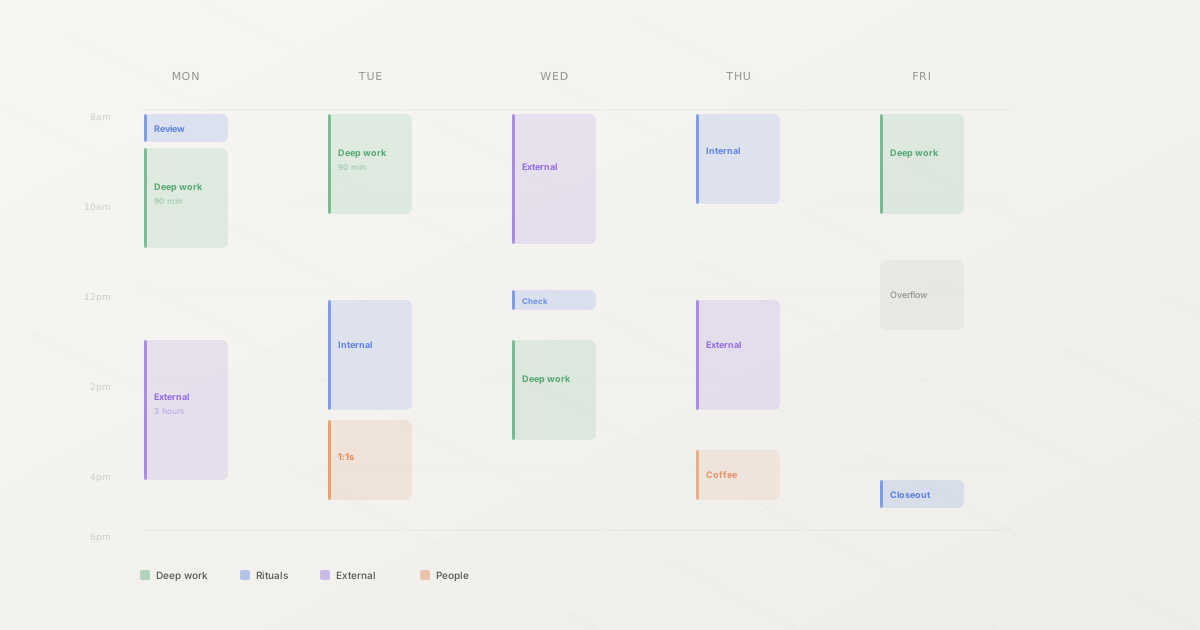
Your week is going to happen whether you design it or not.
If you don’t design it, other people will. Their meeting requests will fill your calendar. Their priorities will become your schedule. By Friday, you’ll look back and realize you spent 40 hours reacting and zero hours on the three things that actually mattered.
This isn’t a time management lecture. It’s a construction manual. In 45 minutes, you’re going to build a weekly template that you can use every Monday morning to shape the week ahead. Not a rigid schedule. A structural frame that protects what matters while staying flexible enough for reality.
Here’s how.
Before you start: the audit (10 minutes)
Before designing your ideal week, you need to understand your actual week. Open your calendar and look at the last two weeks. Answer these questions honestly:
How many meetings did you have per day? Count everything. The “quick sync” counts. The coffee counts. The standup counts. Write the number down.
How many hours of uninterrupted work did you get per day? Uninterrupted means 60+ minutes with no meetings, no calls, no scheduled interruptions. For most operators, this number is lower than they think. Often below 2 hours.
Which meetings produced outcomes? Go through each meeting and mark it: did it produce a decision, an action item, or a relationship advancement? Be honest. If a meeting didn’t produce any of these, it was informational at best and ceremonial at worst.
Where are your energy peaks? You know this intuitively. Some people are sharp at 7am and useless by 3pm. Others ramp up after lunch. Note your two peak-energy windows. These are your most valuable hours and you’re probably wasting them on low-value meetings.
What fell through the cracks? What did you intend to do last week but didn’t? The proposal you meant to write. The relationship you meant to nurture. The follow-up you forgot. These are the casualties of an undesigned week.
This audit takes 10 minutes. Don’t skip it. You can’t design a better structure without understanding what’s broken in the current one.
Step 1: Define your non-negotiables (5 minutes)
Every week has commitments that can’t move. Identify them:
Fixed external commitments. Client calls at specific times. Board meetings. Investor updates. School pickup. These are the foundation stones. Everything else arranges around them.
Deep work blocks. You need a minimum of two 90-minute blocks per week for thinking, writing, or building. Non-negotiable. If you can get four, you’re in the top quartile of operator productivity. These blocks should be placed during your peak energy windows (from the audit above).
Preparation windows. Every important meeting needs at least 10 minutes of preparation. If you have a high-stakes meeting at 2pm, the 15 minutes before it should be blocked for prep. Not “hope I remember to review the notes.” Blocked. On the calendar. Visible.
Buffer time. 15 minutes between back-to-back meetings. This isn’t optional. Research shows that zero-gap meetings degrade decision quality by 20-30% as the day progresses. A 15-minute buffer gives you time to capture action items from the previous meeting, mentally reset, and briefly prepare for the next one.
Personal commitments. Exercise. Family. Whatever keeps you functional. If it matters, it goes on the calendar. If it’s not on the calendar, it doesn’t exist.
Write these down. They form the skeleton of your week.
Step 2: Create meeting batches (10 minutes)
Here’s where most operators go wrong: they accept meetings whenever there’s an empty slot. This creates a Swiss cheese calendar where meetings are scattered randomly throughout the day, making deep work impossible even when there’s technically “free time.”
The fix: batch your meetings.
Internal meetings go in one window. Pick a block of 2-3 hours per day (or concentrate them on specific days) for internal team meetings. Tuesday and Thursday afternoons work well for many operators. The specific timing matters less than the consistency. When your team knows your internal meeting windows, they stop scheduling random 30-minute syncs at 9am.
External meetings go in a different window. Client calls, investor meetings, partnership conversations. These go in a separate batch. Monday and Wednesday mornings, for example. Or Tuesday and Thursday mornings. External meetings tend to require more preparation and generate more follow-up, so batching them creates natural prep-and-debrief cycles.
One-on-ones get their own day. If you manage a team, concentrate your 1:1s into a single half-day. This sounds counterintuitive (won’t I be exhausted?), but the alternative is worse: 1:1s scattered across the week, each one requiring a different context switch. Batching them means you enter “people mode” once and stay there.
Coffees and informal meetings go to edges. Early morning, late afternoon, or lunch. These are lower-energy, relationship-oriented interactions that don’t need your peak cognitive hours. Protect your peaks for deep work and high-stakes external meetings.
The goal isn’t a perfect arrangement. It’s a default structure that reduces context-switching from 15-20 times per day to 3-4.
Step 3: Place your deep work blocks (5 minutes)
You identified your two peak-energy windows in the audit. Now protect them.
Place 90-minute deep work blocks during those peak windows. Mark them as busy or out-of-office on your calendar. Give them a specific name: “Strategy block” or “Writing window” or “Build time.” A named block is psychologically harder to override than an unnamed one.
Two rules for deep work blocks:
They go in first, before any meetings. If you place meetings first and try to find space for deep work in the gaps, you’ll never get it. Deep work blocks are structural. They’re the foundation. Meetings fill the remaining space.
They’re protected by buffer. Don’t schedule a deep work block immediately after a meeting. The context-switching cost will eat the first 20 minutes. Place a 15-minute buffer between the last meeting and the start of deep work.
For most operators, the ideal placement is: one deep work block in the early morning (before meetings start) and one in the early afternoon (after the lunch lull passes). If you can only get one, protect the morning.
Step 4: Build in commute reality (5 minutes)
This is the step that most calendar frameworks ignore. Your calendar says you’re free at 2pm and have a meeting at 3pm across town. Are you actually free until 3pm? No. You’re free until 2:15pm at best, because you need 45 minutes to get there.
For every in-person meeting, add a commute block before it. Use actual travel time estimates (Google Maps with traffic for your usual departure time, not the optimistic “no traffic” estimate). Add 10 minutes of padding.
For meetings at locations you visit frequently, create a mental map of realistic transit times:
Your office to downtown: X minutes at peak, Y minutes off-peak. Home to the co-working space: X minutes. The coffee shop you always use for investor meetings: X minutes from each likely starting point.
Once you’ve estimated commute time for your regular locations, the weekly template becomes more honest. You’ll immediately see where you’ve been over-scheduling: that 2pm meeting across town followed by a 3pm call back at the office was never going to work, but your calendar showed both as “available.”
Commute time is the single biggest source of calendar fiction for operators who mix in-person and remote meetings. Making it visible eliminates a category of daily stress.
Step 5: Add your weekly rituals (5 minutes)
Three rituals separate designed weeks from chaotic ones:
Monday morning review (20 minutes). Every Monday, before you open email, review your week. Look at every meeting. Confirm you have preparation time before each important one. Verify that commute times are realistic. Check for back-to-back conflicts. Identify the 3 most important outcomes you need from this week. Write them down. This review is the single most valuable ritual in the entire framework.
Wednesday midweek check (10 minutes). Halfway through the week, do a quick status check. Are you on track for your 3 weekly outcomes? Has the week deviated from the plan? Do you need to cancel or reschedule anything for Thursday/Friday to protect what matters?
Friday closeout (15 minutes). At the end of Friday (or whenever your week ends), spend 15 minutes on three things: capture any outstanding action items from the week’s meetings, send any follow-ups that are still pending, and do a quick calendar review for the following week to flag any preparation needs.
Block all three rituals on your calendar now. They total 45 minutes per week. The ROI is disproportionate.
Step 6: Assemble the template (5 minutes)
You now have all the pieces. Assemble them into a weekly template. Here’s an example structure for an operator with 20-25 meetings per week:
Monday. Morning: weekly review (20 min) + deep work block (90 min). Afternoon: external meetings batch (3 hours).
Tuesday. Morning: deep work block (90 min). Afternoon: internal meetings batch (2.5 hours) + 1:1s (1.5 hours).
Wednesday. Morning: external meetings batch (3 hours). Midday: midweek check (10 min). Afternoon: deep work block (90 min) + buffer.
Thursday. Morning: internal meetings batch (2 hours). Afternoon: external meetings batch (2.5 hours) + informal coffees.
Friday. Morning: deep work block (90 min) + overflow meetings. Afternoon: admin, follow-ups, Friday closeout (15 min). Lighter schedule by design.
This template gives you: 4 deep work blocks (6 hours), 3 rituals (45 minutes), and structured meeting windows. The specific arrangement should match your energy patterns and fixed commitments from Step 1.
The 80% rule
No week follows the template perfectly. Meetings will be requested at inconvenient times. Emergencies will arise. Clients will only be available during your deep work block.
The goal isn’t 100% adherence. It’s 80%. If 4 out of 5 days roughly follow the structure, you’re winning. The template is a default, not a mandate. Its power comes from having a default at all, because without one, every scheduling decision is made from scratch, under time pressure, with no strategic intent.
When someone requests a meeting during your deep work block, the template gives you a reason to suggest an alternative: “I have a window on Thursday afternoon. Would that work?” Without the template, you’d just say yes because you’re technically “free.”
The template is armor against the tyranny of availability.
Maintaining the template
The biggest risk isn’t building the template. It’s erosion. Week by week, exceptions accumulate. A “just this once” meeting during deep work becomes a habit. The Friday closeout gets skipped because you’re tired. By month two, the template exists on paper but not in practice.
Three defenses against erosion:
Make the template visible. Use recurring calendar events for your deep work blocks, rituals, and buffer times. If they’re not on the calendar, they’ll be treated as free time.
Review monthly. Once a month, compare your actual calendar to your template. Where did it diverge? Was the divergence justified or habitual? Adjust the template if your reality has genuinely changed. Reinforce it if the divergence was drift.
Share it with your team. When your direct reports and assistant know your template, they become allies in protecting it. “She does deep work Tuesday mornings” is more powerful than silently blocking time and hoping nobody notices.
Your week is a design problem. Spend 45 minutes designing it, and the other 2,655 minutes work better.
Tact builds your weekly template automatically from your calendar patterns, protects deep work blocks, calculates real commute times, and runs the Monday review for you. Learn more at usetact.io