The 90-minute focus block: why your brain works in ultradian cycles
Neuroscience says your brain operates in 90-minute concentration cycles. Here's how to design your calendar around them instead of against them.
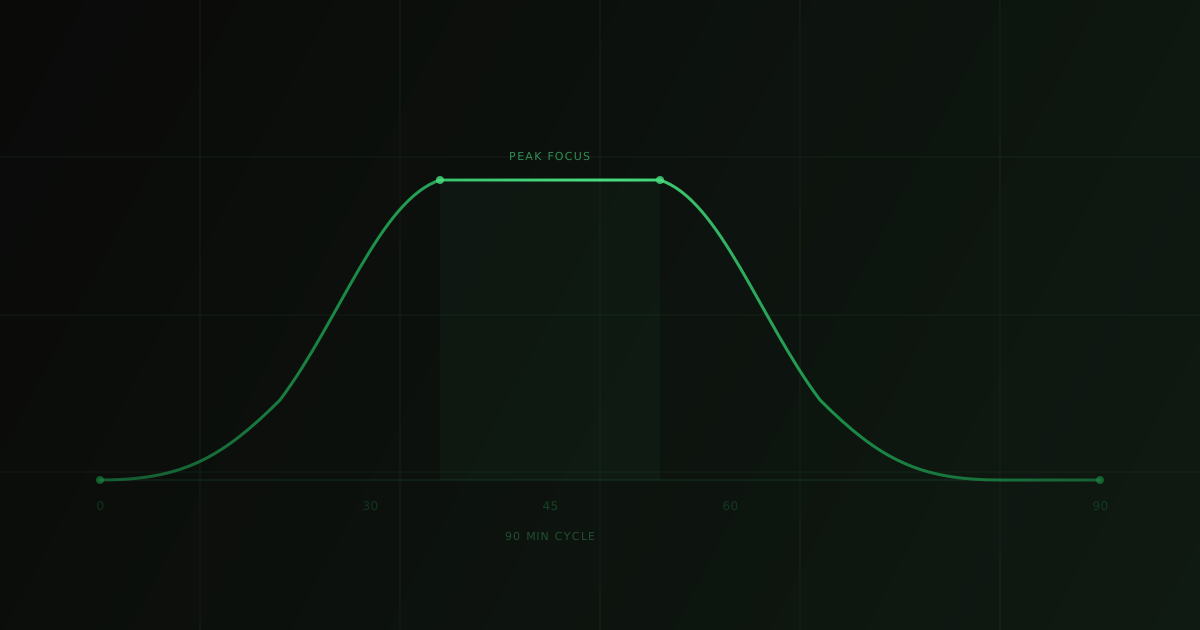
In the 1950s, a sleep researcher named Nathaniel Kleitman discovered something that would take decades to reach the productivity world. Kleitman found that human sleep follows a predictable 90-minute cycle, moving through stages of light sleep, deep sleep, and REM. He called these ultradian rhythms.
What took longer to surface was that these 90-minute cycles don’t stop when you wake up.
Your waking brain follows the same pattern. Roughly every 90 minutes, you cycle between a peak of high alertness and a trough of lower cognitive capacity. This isn’t metaphorical. It’s measurable in EEG patterns, hormonal fluctuations, and performance data. Your ability to concentrate, solve complex problems, and make good decisions oscillates throughout the day in waves that last approximately 80-120 minutes, with 90 minutes as the reliable center.
Most calendars ignore this entirely. Yours doesn’t have to.
The biology of a focus cycle
A single ultradian cycle has three phases.
The ramp (minutes 1-15). Your brain is transitioning into focused mode. Prefrontal cortex activity increases. Distractions are still competing for attention. This phase is fragile. An interruption here (a Slack notification, someone popping in with a question) resets the cycle. You don’t lose 30 seconds. You lose the entire ramp.
The peak (minutes 15-75). This is the productive core. Your prefrontal cortex is fully engaged. Working memory capacity is at maximum. Novel connections between ideas happen here. Complex problems that seemed intractable during the ramp suddenly have structure. This is where your best thinking happens.
If you’ve ever experienced a “flow state,” you know what the peak feels like. Time distortion. Effortless concentration. A sense that the work is pulling you forward. Flow research by Mihaly Csikszentmihalyi maps almost perfectly onto the ultradian peak. Flow isn’t random. It’s the peak of a biological cycle. You can schedule it.
The trough (minutes 75-110). Concentration fades. Your mind starts wandering. You re-read the same paragraph. You check your phone without deciding to. This isn’t weakness. It’s biology. Your brain is signaling that the cycle is ending and it needs recovery before the next one begins.
Fighting the trough is counterproductive. Pushing through doesn’t extend the peak. It produces low-quality work with high effort. The right response is to stop, rest for 15-20 minutes, and let the next cycle begin naturally.
Why 30-minute blocks don’t work
Most calendar tools default to 30-minute or 60-minute blocks. Neither aligns with how your brain works.
A 30-minute “focus block” is almost entirely ramp. By the time your brain reaches the productive peak (around minute 15), you have 15 minutes before the block ends. You never reach the state where complex thinking happens. It’s like warming up for a run and stopping before you actually run.
A 60-minute block is better but still cuts the peak short. You get roughly 45 minutes of productive peak time before the block ends. For simple tasks (email, admin, reviews), 60 minutes is fine. For deep cognitive work (strategy, writing, architecture, analysis), you’re leaving 15-30 minutes of peak capacity on the table.
A 90-minute block captures the full cycle. Fifteen minutes to ramp, sixty minutes of peak productivity, and a natural taper that signals it’s time to stop. You get the complete arc without fighting biology.
This is why the most productive writers, programmers, and thinkers throughout history have converged on roughly 90-minute work sessions, long before anyone understood ultradian rhythms. Ernest Hemingway wrote for 90 minutes each morning. Many professional programmers report that their best coding happens in 90-minute bursts. Chess grandmasters structure their training in 90-minute blocks. The pattern isn’t cultural. It’s biological.
Designing your calendar around cycles
Knowing about ultradian rhythms is useless unless you structure your day to respect them. Here’s how.
Protect 2-3 ninety-minute blocks per day. This is the non-negotiable foundation. Two blocks give you 3 hours of peak cognitive work. Three blocks give you 4.5 hours. For most operators, that’s the maximum sustainable deep work before meeting obligations consume the rest of the day.
The math is important: even at just two blocks per day (3 hours of deep work), you’re producing more high-quality cognitive output than most operators who spend 8 hours in meetings and task-switching.
Place blocks during your chronotype peaks. Not everyone peaks at the same time. Early chronotypes (natural early risers) hit their first ultradian peak between 7-9am. Late chronotypes peak later, often between 10am-12pm. Most people have a second peak in the early-to-mid afternoon (1-3pm), after the post-lunch cortisol dip passes.
You probably know your chronotype intuitively. When do you do your best thinking? That’s your primary block window. Protect it ferociously.
Build 20-minute buffers between blocks. The trough phase of one cycle and the ramp phase of the next need a bridge. A 20-minute break between focus blocks lets your brain complete recovery before the next ramp begins. During this break: move physically, avoid screens, let your mind wander. The default mode network (the brain’s “rest state” network) does important work during these breaks, including consolidating what you just learned and making novel connections.
Never schedule meetings during your primary peak. This is the hardest rule to enforce and the most valuable. Your primary focus block (the one during your chronotype peak) is your most productive 90 minutes of the day. A meeting during this window costs more than 90 minutes. It costs the highest-quality 90 minutes you have.
A common objection: “But my most important meetings need my best thinking.” True. Place your most important meetings during your second peak, not your first. Reserve the first peak for individual deep work, where the full 90-minute cycle can run uninterrupted.
The meeting-focus paradox
Operators face a structural conflict: meetings fragment the day in ways that make 90-minute blocks nearly impossible.
Consider a typical calendar: 9am meeting, 10:30am meeting, 12pm lunch, 1:30pm meeting, 3pm meeting, 4:30pm meeting. The gaps between meetings are 60-90 minutes each, which sounds like enough time for a focus block. But each gap is preceded by a meeting (which requires cognitive recovery) and followed by a meeting (which creates anticipation anxiety). The effective deep work time in a 90-minute gap between meetings is more like 45 minutes, below the threshold for reaching a productive peak.
The solution is batching, which we covered in our guide to designing your ideal week. But the key insight here is about why batching works: it’s not just about efficiency. It’s about creating the uninterrupted 90-minute windows that your biology needs.
A morning with three consecutive meetings (9am-12pm) followed by a 90-minute focus block (12:30-2pm) produces more deep work than a morning with three meetings scattered across 9am-2pm with 45-minute gaps between them. Same number of meetings. Same total time. Dramatically different cognitive output.
What to do during a focus block
Not all tasks deserve a focus block. The ultradian peak is your brain’s highest-performance mode. Use it for work that actually requires that level of cognition.
Use focus blocks for: Strategic planning. Complex writing. Architecture decisions. Financial modeling. Creative problem-solving. Anything where the quality of thinking matters more than the speed of execution.
Don’t use focus blocks for: Email. Slack. Administrative tasks. Simple reviews. Data entry. Calendar management. These tasks can be done during troughs or in the gaps between meetings. They don’t require peak cognitive capacity, and doing them during peak hours is like using a race car to drive to the grocery store.
A simple filter: if the task requires you to hold multiple complex ideas in working memory simultaneously, it’s a focus-block task. If it’s primarily about processing information sequentially, it’s not.
The compounding effect of protected focus
The long-term impact of protecting 90-minute blocks compounds in ways that aren’t immediately obvious.
In the first week, you’ll notice that your deep work output increases. Tasks that took all day when scattered across meeting gaps get done in a single block.
By week four, something subtler happens. Your brain starts to associate the focus block with deep concentration. The ramp phase shortens. You reach peak faster because the ritual of the block primes your brain for focus. Psychologists call this “environmental cueing,” and the same time, same conditions, same duration pattern creates a powerful one.
By month three, the effect is structural. You’ve reclaimed 10-15 hours per week of peak cognitive time that was previously lost to meeting fragmentation. The quality of your strategic thinking is measurably better. Decisions that used to take multiple meetings get resolved in a single focus session. You’re not working more hours. You’re using your best hours better.
Your calendar has the same number of hours as everyone else’s. The difference is whether those hours are arranged to work with your biology or against it.
Ninety minutes. That’s the unit. Design around it.
Tact automatically identifies your focus windows based on meeting patterns and protects them from scheduling conflicts. Because your best 90 minutes shouldn’t be interrupted by a “quick sync.” Learn more at usetact.io