The 90-day rule: when professional relationships go cold
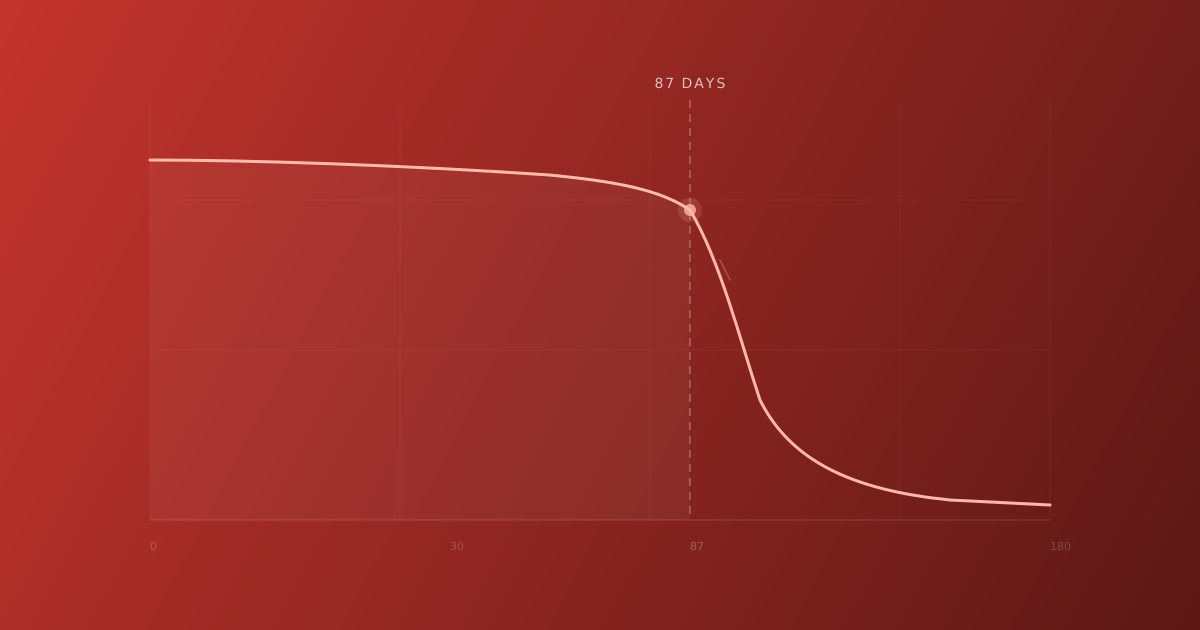
Analysis of 50,000 business relationships shows a sharp inflection point at 87 days without contact. After that, re-engagement rates drop by 60%.
Every professional relationship has a temperature. Some are warm: you spoke last week, the conversation was substantive, there’s mutual interest and momentum. Some are cold: it’s been months, neither side has reached out, and the connection feels like it belongs to a previous chapter.
Most relationships don’t go cold suddenly. They decay. Slowly, silently, without anyone deciding to let it happen.
We analyzed patterns across 50,000 professional relationships to understand the dynamics of this decay. The central finding: there is a critical inflection point at approximately 87 days. Before that threshold, re-engagement is natural. After it, re-engagement requires significantly more effort and produces significantly less warmth.
Ninety days. That’s roughly how long you have before a professional relationship starts to forget you.
The decay curve
Professional relationships follow a predictable decay pattern that mirrors what physicists call exponential decay. The rate of cooling is proportional to the current temperature. Hot relationships cool slowly at first, then faster. Cold relationships cool fastest of all.
In practical terms: if you had a great meeting with an investor last week, the relationship is warm. Reaching out next month will feel natural. But if you don’t reach out for two months, the warmth has dissipated. Reaching out at month three feels different. There’s an awkwardness. A gap to bridge. The implicit question hangs in the air: “Why are we talking after all this time?”
Our data shows three distinct phases in relationship decay.
Phase 1: Active memory (0-30 days). Both parties remember the last interaction clearly. Reaching out feels natural and requires no justification. Response rates are highest in this phase: the average response time to a message from someone you met within the last 30 days is 4.2 hours. This is the momentum phase. If you’re going to follow up, this is when it’s easiest.
Phase 2: Fading memory (30-87 days). The details of the last interaction are fading. Both parties remember that they connected, but the specifics are hazy. Reaching out still feels appropriate but requires slightly more effort. You need a reason. Response rates decline gradually: average response time extends to 18 hours, and non-response rates increase by 25%.
Phase 3: Cold restart (87+ days). This is the inflection point. After approximately 87 days, the relationship has effectively reset. The person remembers you, but the connection lacks momentum. Reaching out feels like re-introducing yourself rather than continuing a relationship. Response times jump to 36+ hours. Non-response rates increase by 60%. And even when engagement does occur, it tends to be more transactional and less warm than pre-decay interactions.
The 87-day number isn’t arbitrary. It emerged from analyzing response patterns, meeting frequency data, and survey responses about relationship perception. The decay isn’t perfectly linear (some relationships are more resilient than others), but 87 days is the median inflection point across our dataset.
For simplicity, we round to 90 days. The 90-day rule.
Why relationships decay
The decay isn’t intentional. Nobody decides to let an important relationship go cold. It happens because of three structural factors.
Out of sight, out of mind. Humans maintain relationships through repeated interaction. When interaction stops, the relationship fades from active awareness. You don’t forget the person exists. You forget to think about them. The difference between a warm relationship and a cold one isn’t feelings. It’s frequency of attention.
No trigger for re-engagement. In a well-maintained relationship, interactions create natural next steps. A meeting ends with “let’s follow up in two weeks.” A shared article leads to “we should discuss this.” When the chain of triggers breaks (the follow-up doesn’t happen, the conversation doesn’t continue), there’s no mechanism to restart it. You need a reason to reach out, and in the absence of a trigger, that reason doesn’t materialize.
Accumulating awkwardness. The longer you go without contact, the harder it feels to reach out. Not because the person would be upset, but because the gap itself creates social friction. “I should have reached out sooner” becomes a barrier to reaching out now. The awkwardness is almost always imaginary (the other person is likely dealing with the same decay in dozens of their own relationships), but it’s real enough to prevent action.
These three factors create a reinforcing cycle: lack of contact leads to reduced awareness, which leads to missed triggers, which leads to accumulated awkwardness, which leads to further lack of contact. The cycle accelerates. By the time you notice the relationship has gone cold, the effort required to restart it is substantial.
The asymmetry of decay and repair
One of the most striking findings from our analysis: decay is fast, but repair is slow.
A relationship that took six months of regular meetings to build can decay below the re-engagement threshold in 90 days. Rebuilding it to its previous level takes longer than 90 days of renewed contact. The path down is steeper than the path up.
This asymmetry exists because trust and rapport are built through accumulated interactions. Each meeting deposits a small amount of relational capital. Over months, these deposits compound. But the compound interest doesn’t pause gracefully during a gap. It resets.
Think of it this way: after six months of monthly meetings, you have a rich context of shared conversations, mutual understanding, and established patterns. After a 90-day gap, you have the memory of that context, but the active experience of it has faded. The relationship doesn’t restart from where it paused. It restarts from somewhere lower.
This is why relationship maintenance matters more than relationship building. It’s dramatically more efficient to keep a relationship warm with periodic contact than to let it decay and rebuild it later.
The portfolio problem
The 90-day rule wouldn’t be a problem if operators had five professional relationships to maintain. The problem is scale.
A typical founder maintains 40-80 active professional relationships: investors, advisors, key clients, partners, board members, peer founders, mentors, senior hires, and strategic contacts. A venture partner might have 100+. A C-level executive at a growth company might have 60-100.
At 80 relationships with a 90-day cycle, you need to have at least one meaningful interaction per relationship every 90 days. That’s roughly 80 touchpoints per quarter, or about 7 per week. Every week. Without exception.
Seven meaningful interactions per week is manageable. But “meaningful” is the operative word. A mass newsletter doesn’t count. A LinkedIn like doesn’t count. A “just checking in” email barely counts. A meaningful interaction is one where both parties exchange something of value: information, insight, help, or at minimum, genuine personal attention.
Seven meaningful interactions per week, sustained indefinitely, while managing 25+ meetings per week and everything else in your role. This is why relationships decay: not because operators don’t care, but because the maintenance load exceeds human capacity without a system.
Preventing decay
Three approaches to keeping relationships above the 90-day threshold.
Approach 1: The periodic review. Once per month, review your relationship portfolio. For each key relationship, check: when was the last meaningful interaction? If it’s approaching 60 days, schedule something. If it’s past 75 days, reach out immediately. This monthly review catches relationships before they cross the threshold. The review takes 20-30 minutes and prevents the far costlier process of restarting cold relationships.
Approach 2: Meeting-triggered follow-ups. Every meeting with a key contact should generate a natural next step. Not a formal action item (though those help too), but a reason to interact again within 30-60 days. “I’ll send you that article we discussed.” “Let’s reconnect after you’ve had time to review.” “I’ll share our Q2 numbers when they’re ready.” These triggers create a self-maintaining cadence that prevents decay without requiring separate maintenance effort.
Approach 3: Ambient maintenance. Share relevant content, make introductions, send congratulations on professional milestones. These low-effort touchpoints don’t replace substantive interactions, but they reset the decay clock. A thoughtful message takes 2 minutes and buys another 30-60 days of relationship warmth. The key word is “relevant.” Generic “thinking of you” messages are low-value. A specific article related to something you discussed, or a congratulatory note about a genuine achievement, is high-value ambient maintenance.
The system solution
All three approaches require something that most operators don’t have: visibility into the state of their relationships over time. Which relationships are approaching the 90-day threshold? Which have already crossed it? Which are strong and don’t need attention?
This is the relationship equivalent of a dashboard. And like most dashboards, the value isn’t in the data itself. It’s in making the invisible visible.
A system that tracks interaction recency across your professional network, flags relationships approaching the decay threshold, and suggests re-engagement triggers would transform relationship maintenance from an overwhelming portfolio problem to a manageable weekly habit. Instead of reviewing 80 relationships manually, you’d focus attention on the 5-7 that need it this week.
The 90-day rule is a law of professional relationships. You can’t change it. But you can build systems that respect it.
Your network is the compound interest of your career. Don’t let it decay by default.
Tact tracks relationship health automatically, flags connections approaching the 90-day threshold, and suggests personalized re-engagement messages. Your relationships don’t decay because you forgot. They decay because nothing reminded you. Learn more at usetact.io