The 2026 Operator Productivity Report
We surveyed 1,200 founders and C-levels. Here's how operators actually spend their time, and where the biggest inefficiencies hide.
Every productivity framework starts with the same assumption: you know where your time goes.
You don’t.
We surveyed 1,247 founders, C-level executives, and senior operators across 14 countries in January 2026. We asked them to estimate how they spend their working hours. Then we compared their estimates to actual calendar data from a subset of 340 respondents who opted in to anonymous analysis.
The gap between perception and reality was the most striking finding.
Methodology
The survey was distributed through founder communities, executive networks, and our early access program. Respondents were screened for roles: 41% were founders or co-founders, 28% were C-level executives (CTO, COO, CMO, CFO), 18% were VPs or directors, and 13% were investors or board members. Company stages ranged from pre-seed to public, with the majority (62%) between seed and Series C.
The calendar data analysis covered 340 respondents who connected one or more calendars anonymously. We analyzed 47,000+ calendar events across a 4-week period, tracking meeting count, duration, gaps between meetings, attendee patterns, and time-of-day distribution.
All data presented here is aggregated. No individual data was shared or stored beyond the analysis period.
Finding 1: The meeting load is higher than anyone admits
When asked “how many meetings do you have in a typical week?”, the average response was 18.
The actual average from calendar data was 24.3.
This 35% undercount is consistent across roles. Founders estimated 20, actual was 27.1. C-levels estimated 17, actual was 22.8. The only group that was roughly accurate was investors, who estimated 16 and averaged 16.9. (Investors, it turns out, are better at counting because meetings are their primary output.)
Why the gap? Operators don’t count certain types of meetings. Quick 15-minute syncs, “informal” coffees, and internal standups are mentally categorized as non-meetings. But they consume the same resource: time, attention, and context-switching cost.
The real number that matters isn’t meeting count. It’s meeting hours.
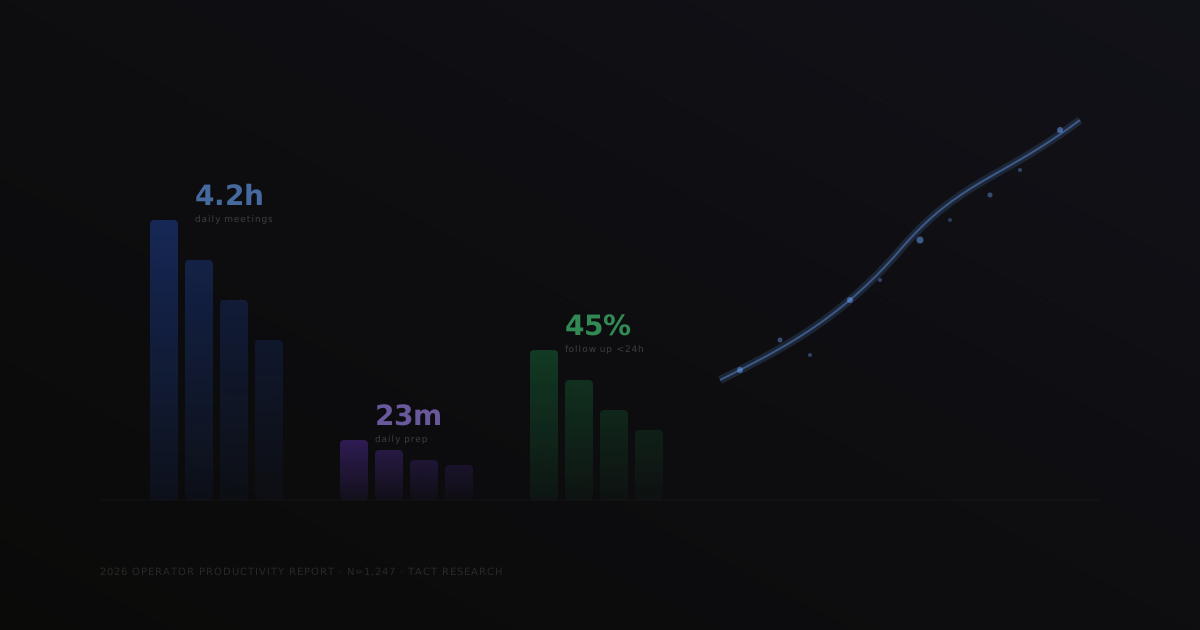
The average operator in our sample spends 4.2 hours per day in meetings. That’s 21 hours per week in a 5-day workweek. For founders, it’s 4.8 hours (24 hours/week). For C-levels, it’s 3.9 hours (19.5 hours/week).
In a 10-hour workday (which 73% of respondents reported as typical), meetings consume 42-48% of total working time. The remaining 52-58% is split between email/messaging (estimated at 1.5 hours/day), preparation and follow-up (estimated at 1.1 hours/day), and actual deep work.
The deep work window, the time available for strategic thinking, writing, building, or analyzing, averages 2.4 hours per day. For founders, it’s 1.9 hours.
Less than two hours of deep work per day. For the people making the most consequential decisions in their organizations.
Finding 2: Meeting preparation is almost nonexistent
We asked: “How much time do you spend preparing for meetings?”
The average response: 23 minutes per day.
Spread across an average of 4.8 daily meetings, that’s less than 5 minutes of preparation per meeting.
When we asked respondents to self-assess their preparation quality on a 1-5 scale, the average was 2.8. Most operators know their preparation is inadequate. They just don’t have time to fix it.
The preparation gap creates a cascade of downstream problems. Meetings without preparation run longer (our data shows unprepared meetings average 38 minutes vs. 29 minutes for prepared ones). They produce fewer decisions (1.2 decisions per meeting vs. 2.1 for prepared meetings, based on respondent self-reports). And they generate more follow-up meetings. A meeting that doesn’t resolve its agenda creates another meeting.
We call this the preparation debt cycle: skip preparation, have a longer and less productive meeting, generate follow-up meetings, have even less time for preparation. The cycle compounds weekly.
The single highest-leverage intervention for meeting productivity is preparation, not better note-taking, not better scheduling, not fewer meetings. Preparation.
Finding 3: Follow-up is where knowledge goes to die
This was the finding that surprised us most.
We asked: “After a meeting with a decision or commitment, how quickly do you follow up?”
- Within 1 hour: 11%
- Within 24 hours: 34%
- Within 48 hours: 24%
- Within a week: 19%
- Rarely or never: 12%
Only 45% of operators follow up within 24 hours. And the ones who do rarely send substantive follow-ups. Most are one-line “thanks for the chat” messages.
When we cross-referenced follow-up speed with respondent-reported outcomes, the correlation was stark. Operators who follow up within 1 hour reported 3.2x higher “meeting-to-outcome” conversion (defined as: the percentage of meetings that produce a measurable next step that actually happens). Those who follow up within 24 hours reported 2.1x. Beyond 48 hours, the multiplier drops below 1x. The meeting effectively didn’t happen.
The reason is simple: memory degrades exponentially. Within 24 hours, you’ve forgotten 50-70% of what was discussed (the Ebbinghaus curve is well-documented). The nuance, the specific phrasing, the emotional context, the small commitments that felt important in the moment: all gone. What remains is a vague impression. And vague impressions don’t produce specific follow-ups.
The follow-up gap is the single largest destroyer of meeting ROI. Organizations invest enormous time and energy getting people into rooms together, then let the output evaporate because nobody captured and acted on what was discussed.
Finding 4: Relationship tracking is purely mental
We asked: “How do you track the health of your professional relationships?”
- I keep it in my head: 64%
- I use a CRM: 18%
- I use spreadsheets or notes: 11%
- I use a dedicated tool: 3%
- I don’t actively track: 4%
Nearly two-thirds of operators rely on memory alone to track their most important professional relationships. The 18% who use a CRM overwhelmingly reported that it captures contact information and deal stages, not relationship health.
When we asked “In the past 6 months, have you realized too late that an important professional relationship had gone cold?”, 71% said yes.
The most common triggers for this realization were:
- Someone else mentioned the person, and the operator realized they hadn’t spoken in months (39%)
- The operator needed something from the person and realized the relationship had decayed (28%)
- The person reached out after a long silence, creating an awkward dynamic (18%)
- A deal or opportunity was lost, and the operator traced it back to insufficient relationship maintenance (15%)
The pattern is consistent with what we described in our thesis essay: relationships have a half-life. Our data suggests the inflection point is around 87 days. After approximately three months without meaningful contact, re-engagement becomes significantly harder. Response rates drop. Warmth dissipates. Trust, which compounds with regular interaction, starts to reset.
No operator intentionally lets relationships decay. They decay because there’s no system to make the decay visible.
Finding 5: The coordination tax is massive but invisible
How much time does it take to schedule a meeting? The intuitive answer is “a minute or two.”
The actual answer, from our calendar data analysis, is more complex.
For meetings with external parties (clients, investors, partners), we tracked the time between the first scheduling message and the confirmed calendar event. The median was 3.2 days. The average number of back-and-forth messages was 4.7.
Assuming each message takes 2-3 minutes to compose, read, and respond to (factoring in context-switching cost), the coordination overhead for a single external meeting is 10-15 minutes.
The average operator in our sample has 8.3 external meetings per week. That’s 80-125 minutes per week spent on scheduling alone. Over a year: approximately 70-110 hours. We used 90 hours as the midpoint in our analysis. Other studies have found even higher numbers (Harvard Business Review estimated 140 hours for senior executives).
This doesn’t include the cognitive load of scheduling. Every scheduling decision requires checking availability across multiple calendars, estimating travel time, considering energy levels (putting a board meeting after a 3-hour flight is a mistake), and predicting conflicts. This is project management disguised as a simple calendar check.
Scheduling isn’t an administrative task. It’s a resource allocation problem masquerading as logistics.
Finding 6: The back-to-back trap
We analyzed meeting gap patterns in our calendar dataset. The results confirmed what every operator feels but rarely quantifies.
34% of all meetings had zero gap to the next meeting. The previous meeting’s end time was the next meeting’s start time. Back-to-back, no buffer.
An additional 28% had gaps of 5 minutes or less. Enough time to grab water, not enough time to process what just happened, prepare for what’s next, or handle the action items from the meeting that just ended.
Only 18% of meetings had gaps of 15 minutes or more.
The research on cognitive recovery between tasks is clear. Context-switching costs 15-25 minutes of productive capacity (Gloria Mark’s research at UC Irvine). A 5-minute gap between meetings doesn’t provide recovery. It provides just enough time to feel stressed about not having enough time.
When we segmented by meeting gap patterns, operators with average gaps of 15+ minutes reported:
- 31% higher self-rated decision quality
- 40% more action items completed within 24 hours
- 23% lower self-reported stress levels
Buffer time between meetings isn’t a luxury. It’s infrastructure for decision quality.
Finding 7: The best operators share three habits
In the top quartile of self-reported productivity (operators who rated themselves 4+ out of 5 on “I feel in control of my time”), three behavioral patterns were statistically overrepresented:
They time-block proactively. 78% of top-quartile operators use some form of weekly time-blocking, compared to 34% of the bottom quartile. They don’t just accept meetings. They design their weeks in advance, protecting specific windows for deep work, batching similar meetings, and building in transition time.
They debrief within minutes, not hours. 67% of top-quartile operators capture meeting notes or action items within 10 minutes of a meeting ending, compared to 19% of the bottom quartile. The method varies (voice memos, quick notes, AI transcription) but the habit is consistent: capture while context is fresh.
They audit their calendar weekly. 72% of top-quartile operators spend time on Sunday or Monday morning reviewing their upcoming week, compared to 28% of the bottom quartile. This review isn’t just checking what meetings exist. It’s assessing whether the week is structured to produce the outcomes they need: enough deep work, proper preparation time, manageable meeting density, and strategic relationship maintenance.
None of these habits require special tools. All of them require intentionality about how time is allocated. The operators who feel in control of their time aren’t working fewer hours. They’re making deliberate choices about how those hours are spent.
The takeaway
The data tells a consistent story: the modern operator’s workday is consumed by meetings, but the infrastructure around those meetings (preparation, capture, follow-up, and relationship tracking) is largely manual, unreliable, or nonexistent.
The highest-leverage improvements are not about having fewer meetings (though some could be eliminated). They’re about making the meetings you have more effective by preparing properly, capturing what happened, following up promptly, and maintaining the relationships that those meetings are supposed to serve.
Here’s the math: if better preparation saves 10 minutes per meeting (by reducing meeting length), and you have 24 meetings per week, that’s 4 hours per week recovered. If automated follow-up captures 30% more action items, and those items have a 2x completion rate, the compounding effect on outcomes is substantial. If relationship tracking prevents even 2-3 key relationships per quarter from going cold, the revenue and opportunity cost avoided is significant.
The gap isn’t effort. Operators are working harder than ever. The gap is infrastructure. The tools that connect calendar, preparation, meetings, follow-up, and relationships into a single system.
That’s the gap Tact is built to close.
This report is based on survey data from 1,247 respondents and calendar analysis from 340 anonymous participants conducted in January 2026. Full methodology and data tables are available upon request at research@usetact.io.
Tact is the AI operating system for executives, founders, and operators. Learn more at usetact.io